AI Music Prompts: Get Multiple Verses, Bridges, Outros
Stop letting AI music apps default to one verse and a repeating chorus. Prompt patterns for full verse-chorus-verse-chorus-bridge-chorus structure with distinct lyrics and clean outros.
The single most common complaint I hear from songwriters using AI music apps is that the generated tracks default to short, simple structures — one verse, a chorus that repeats, maybe a second verse if you're lucky, often no bridge, and frequently an ending that fades awkwardly rather than resolving cleanly. The complaint is fair. Most AI music apps in 2026 do default toward shorter and more repetitive structures unless you specifically prompt for longer form. The good news is that the prompt techniques to overcome this exist, work consistently, and don't require any advanced music theory knowledge.
This is the case for structural prompting in AI music that almost no quick-start guide covers. The defaults are short because shorter is faster to generate and easier to land at decent quality. Getting longer-form work with multiple distinct verses, a working bridge, and a clean outro requires explicit prompt direction — you have to tell the AI what structure you want and supply the lyrics that match. With the right prompt patterns, AI music apps in 2026 can produce 3-4 minute songs with proper verse-chorus-verse-chorus-bridge-chorus form, distinct lyrics per verse, a bridge that actually does something musically different, and a clean resolving outro.
This guide is the structural prompting workflow I have refined across hundreds of test generations. The reason AI defaults to short, the explicit prompt patterns that produce long-form work, how to write multiple distinct verses, how to make bridges that land, and how to prompt for outros that resolve cleanly rather than fade awkwardly.
Why AI music apps default to short and repetitive
A few specifics about why AI music defaults trend toward shorter and more repetitive forms.
Shorter tracks have higher per-second quality at any given model capability. The constraints of generation budget mean a 60-second track gets more attention per second than a 4-minute track. AI music apps default to shorter outputs in part because shorter outputs are more reliable.
Repetition is the AI's safest move. When the model isn't sure what should happen next, repeating what already happened is a low-risk decision. AI music apps repeat the chorus more than they need to because each repeat is a known-safe choice; deviating into a bridge requires more compositional judgment.
Most users want quick results, not careful long-form work. The default audience for AI music apps in 2026 is content creators and personal-occasion users who want a track fast. The product UX is optimized for that audience. Songwriters wanting full long-form structure are a more specialized use case that requires reading past the defaults.
Bridges are the hardest part of song structure for AI to do well. A real bridge changes key, introduces new melodic material, builds tension, and returns to the chorus with renewed energy. Most AI generations either skip the bridge entirely or generate something that is just another verse rather than a true bridge.
Outros are often poorly handled. AI music apps in 2026 frequently end tracks with abrupt cuts, awkward fades, or arbitrary endings. Getting a track to end on a clean musical resolution requires explicit prompting.
The defaults are not the limits. All of the above are about defaults, not about model capability. AI music apps in 2026 can produce long-form structured work when prompted explicitly; they just don't do it without direction.
For the foundational prompt-craft, how to write AI song prompts that actually produce great music covers the universal prompt patterns.
The structural prompt patterns that work
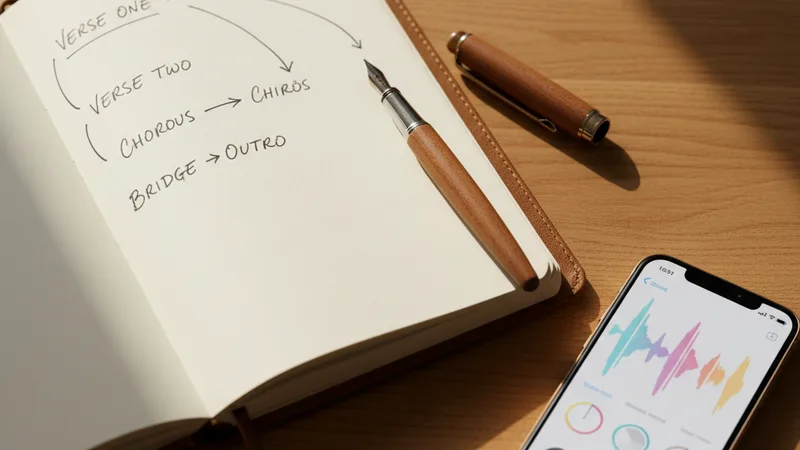
The prompt elements that reliably produce long-form structured AI tracks in 2026.
1. Specify the song form explicitly. "Verse-chorus-verse-chorus-bridge-chorus structure" or "AABA form" or "verse-pre-chorus-chorus-verse-pre-chorus-chorus-bridge-chorus" tells the AI what structural sections to include. Without this direction, the AI may default to just verse-chorus or verse-chorus-verse.
2. Specify each section's length in bars or seconds. "Eight-bar verses, eight-bar choruses, eight-bar bridge" gives the AI structural targets. Bar counts are usually more reliable than seconds because they map to musical phrase logic. If your AI music app responds better to seconds than bars, use "each verse 20 seconds, each chorus 20 seconds, bridge 16 seconds, outro 10 seconds."
3. Specify the total track length. "Three minutes and twenty seconds total" sets the overall constraint. The AI distributes the sections to fit. Without a total length, the AI may end up shorter than you want.
4. Use structural tags in the lyrics field where supported. Some AI music apps (Suno notably) support explicit [Verse 1], [Verse 2], [Chorus], [Bridge], [Outro] tags in the Write Lyrics field. Use these where supported. They directly map to the AI's section generation.
5. Write distinct lyrics for each verse. This is the single most underused prompt technique. Don't write "verse one" and let the AI repeat it as verse two. Write two distinct verses with different concrete imagery. The AI uses the lyric differences to make the verses sound distinct.
6. Write bridge lyrics that are tonally different from verses. The bridge should feel different. Different chord progression, different lyric register, different emotional position in the story. Write lyrics that justify the musical difference.
7. Specify the outro behavior. "Clean ending on the tonic with a final held chord" or "soft outro fading over the last fifteen seconds with the chorus melody returning quietly" or "abrupt clean ending on the four" — pick one and specify it. Vague "ending" or no direction produces awkward fades.
8. Add structural performance direction. "Build energy from verse one through verse two, peak in the chorus, drop the energy in the bridge, return to peak in the final chorus, soft outro." The dynamic arc is part of the structure.
A combined working prompt for a full verse-chorus-verse-chorus-bridge-chorus pop song:
"Modern indie pop song, 110 bpm, confident and dreamy, verse-chorus-verse-chorus-bridge-chorus structure with eight-bar sections, total length three minutes twenty seconds, solo female vocal warm and clear with light harmony in the choruses, fingerpicked acoustic guitar with light synth pad on the verses, full drums entering on the second verse, key change up one whole step at the start of the final chorus, soft drop on the bridge with just piano and vocal, full energy return on the final chorus, clean ending on the tonic with a final held vocal note over a soft piano outro, mastered for streaming with prominent vocals."
In testing, that prompt structure produces a long-form pop track on roughly three to four generations about 75% of the time. For more on iterating prompts, the perfect prompts breakdown covers the underlying patterns.
Writing multiple distinct verses

The lyric-writing approach that produces distinct verses (rather than the AI just repeating a single verse).
Each verse should advance the story. The simplest songwriting frame is: verse one sets the scene, verse two advances the conflict or stakes, the chorus is the central emotional statement, the bridge is the moment of reflection or shift, the final chorus is the resolution. Write each verse with that progression in mind.
Each verse should have its own concrete imagery. Don't repeat the same images. If verse one is about a road trip, verse two can be about the destination or the return. The differences in imagery give the AI vocal performance something to lean into.
Each verse should have its own emotional register. Verse one might be hopeful; verse two might be reflective; verse three (if there is one) might be uncertain. The emotional arc carries the song.
Use the same chorus throughout (with possible variations). The chorus is the centerpiece. Repeating it cements the emotional core of the song. Small variations on the final chorus (different lyric in one line, harmonic key change) keep it from feeling stale on the third repeat.
Example verse one and verse two with clear distinction:
Verse one:
"Friday night, the windows down, the highway out of this small town, I told you I would never go, now the radio is playing slow."
Verse two:
"Wednesday morning, the kitchen light, the things you never said quite right, I told you I would always stay, the highway is calling me away."
The two verses share a structural rhyme scheme (AABB) and a common tempo and meter, but the imagery is different (Friday night/Wednesday morning, highway out/highway calling) and the emotional position is different (driving away/being called back).
For longer songs (3-part verse structures), the third verse should resolve. "Sunday evening, the porch light on, the things I learned since I've been gone, I told you I would always know, the highway always brings me home."
The bridge should sit emotionally between verses. Often the bridge is a moment of stepping outside the story to comment on it: "Maybe the road was never the point, maybe the porch light was, all the long quiet way to know."
For deeper lyric craft, the how to make an AI song from your lyrics step-by-step guide covers the lyric-first AI music workflow in depth.
Step-by-step: a long-form song in Muziko

The workflow for generating a full-structure long-form AI track in Muziko on iPhone or iPad.
1. Open Muziko. Switch to Write Lyrics mode (this mode is required for multi-verse work because the lyrics drive the section differentiation).
2. Pick the genre and mood. Most genres support long-form prompting. Pop, country, indie folk, soul, R&B, and lo-fi work especially well. Higher-energy genres (EDM, trap, hip-hop) often default to shorter forms; you'll need to push the structural prompt harder.
3. Write the lyrics in full sections. Format them like this:
[Verse 1]
Friday night, the windows down,
the highway out of this small town,
I told you I would never go,
now the radio is playing slow.

[Chorus]
And the road keeps singing your name,
and the road keeps singing your name,
in every long quiet town we passed through,
the road keeps singing your name.

[Verse 2]
Wednesday morning, the kitchen light,
the things you never said quite right,
I told you I would always stay,
the highway is calling me away.

[Chorus]
[Same chorus as before]

[Bridge]
Maybe the road was never the point,
maybe the porch light was,
all the long quiet way to know,
all the long quiet way to know.

[Chorus - final]
[Same chorus with a slight melodic lift on the final line]

[Outro]
The road keeps singing your name.
The [Verse 1], [Verse 2], [Chorus], [Bridge], [Outro] tags are recognized by some AI music apps as section markers. Muziko's lyric field handles them; Suno explicitly supports them.
4. Write the prompt note with structural direction. Specify the form, the section lengths, the total length, the dynamic arc, and the ending. Example:
"Modern indie folk song, 95 bpm, sentimental and reflective, verse-chorus-verse-chorus-bridge-chorus structure with eight-bar verses and choruses and a sixteen-bar bridge, total length three minutes thirty seconds, solo female vocal warm and intimate with light harmony in the choruses, fingerpicked acoustic guitar with light piano figure on the second verse, soft strings entering on the bridge, build energy through verses one and two with peak energy on the second chorus, drop the energy on the bridge with just piano and vocal, return to full energy on the final chorus with a key change up one whole step, soft outro with the road keeps singing your name held over fading piano, clean ending on the tonic."
5. Generate four to six takes. Long-form prompts have lower hit rates than short prompts because more things have to land. Generating more takes increases the chance one of them lands the full structure cleanly.
6. Listen for structure. Did the AI distinguish verse one from verse two musically? Did the bridge feel different? Did the final chorus have the promised lift? Did the outro resolve cleanly? Pick the take where most of these landed.
7. Iterate the prompt if needed. If the bridge didn't land, prompt with stronger bridge direction. If the verses sound too similar, change the verse lyrics to be more distinct. If the outro fades awkwardly, prompt for "clean held final chord" more explicitly.
For the broader mobile workflow, the AI song generator for iPhone 2026 guide covers each creation mode in depth.
Song structure forms: a starter chart
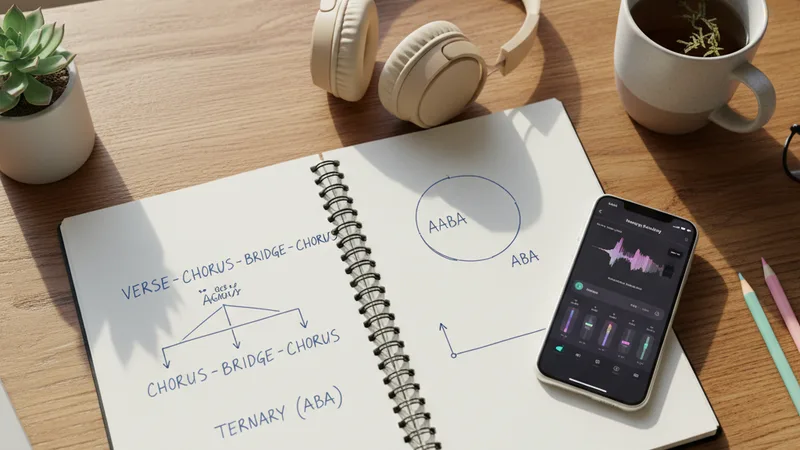
The most common song forms across modern popular music, with prompts that consistently produce each.
| Form | Structure | Use case | Prompt direction |
|---|---|---|---|
| Verse-Chorus | V-C-V-C | Short pop hits, TikTok hooks | "Verse-chorus alternation, two of each, ninety seconds" |
| Verse-Chorus-Bridge-Chorus (VCBC) | V-C-V-C-B-C | Standard pop ballad, most modern pop | "Verse-chorus-verse-chorus-bridge-chorus, three minutes thirty" |
| VC-PC-C-V-PC-C-B-C | V-PreC-C-V-PreC-C-B-C | Modern pop with pre-chorus build | "Pre-chorus building into the chorus on both verse pre-chorus sequences" |
| AABA | A-A-B-A | Jazz standards, Tin Pan Alley | "AABA form, the A sections share melody, B section contrasts, four A sections of sixteen bars each" |
| Through-composed | A-B-C-D-E | Folk ballads, art songs, narrative songs | "Through-composed, no repeated sections, narrative progression, four minutes" |
| Sonata-Allegro | Exposition-Development-Recapitulation | Classical instrumental | Very specific; AI handles approximately at best |
| Twelve-Bar Blues | Repeating 12-bar pattern | Blues, jazz blues | "Twelve-bar blues form, four choruses, simple I-IV-V progression" |
| Verse-Refrain (folk) | V-R-V-R-V-R | Traditional folk, narrative folk | "Verse-refrain alternation, three verses each with new lyrics, same refrain" |
| Strophic | A-A-A-A | Hymns, folk songs | "Strophic form, four identical melodic sections with different lyrics" |
| Verse-Chorus with Drop (EDM) | V-PreC-Drop-V-PreC-Drop-Breakdown-Drop | Modern EDM | "EDM verse with build, drop, verse with build, drop, breakdown, final drop" |
| Intro-Verse-Hook-Verse-Hook-Bridge-Hook (rap) | I-V-H-V-H-B-H | Modern hip-hop | "Intro, verse, hook, verse, hook, bridge, final hook" |
| Quiet-Loud-Quiet (post-rock) | Quiet build, loud climax, quiet resolution | Post-rock, indie | "Quiet sparse opening, build through the middle section, loud climax, quiet resolution outro" |
Pick the form that fits your song. Prompt explicitly. Provide lyrics for each labeled section. The AI follows when you give it enough structural guidance.
For specific genres that benefit from particular forms, see the AI country guide, AI jazz guide, and AI EDM guide for genre-specific structural conventions.
When long-form structural prompting works — and when it doesn't

Honest accounting of where structural prompting lands cleanly and where AI still falls short.
Works well:
- Standard pop verse-chorus-bridge-chorus form. This is the most common modern song form and the form AI music apps in 2026 handle best.
- Country and folk songs with multi-verse storytelling. The AI can handle three or four distinct verses with linked but distinct lyrics.
- R&B and soul ballads with strong bridges. The genre conventions support the bridge structure and AI follows them.
- EDM with build-drop structure. Modern EDM song forms have well-established structural conventions AI follows.
- Hip-hop with verse-hook alternation and a bridge. Modern rap structures are AI-friendly.
- Lo-fi and ambient with longer atmospheric sections. Lo-fi tracks can be longer because the AI repeats subtle textures rather than needing distinct sections.
Less reliable:
- Real sonata form and classical developmental form. AI tends to produce sectional approximations rather than true developmental writing. See the AI classical guide for the honest classical limits.
- Through-composed long-form pieces (5+ minutes with continuous development). AI tends to sectionalize the work rather than develop it continuously.
- Real key changes that work harmonically. Prompting for a modulation often produces a less-than-clean modulation; AI handles common pop modulations (up one whole step in the final chorus) but struggles with more sophisticated harmonic shifts.
- Multi-section instrumental pieces with motivic development. Like the classical limit, AI doesn't develop motifs across sections the way a human composer would.
- Songs over 4 minutes with maintained interest. The longer the track, the more likely the AI generation becomes repetitive or loses energy. 4 minutes is roughly the practical upper limit for high-quality AI generation in 2026.
Doesn't work yet:
- Counterpoint between verses (two independent melodic lines). AI generates homophonic textures (melody plus accompaniment) more reliably than contrapuntal textures.
- Real fugue structure. Subject, answer, episodes, stretto — beyond current AI form modeling.
- Operatic recitative followed by aria. The classical opera form isn't well-handled.
- Variable-tempo songs with intentional rallentandos and accelerandos. AI tends to stay at a fixed tempo throughout.
For the broader form-by-genre breakdown, the AI classical guide covers classical forms specifically and the AI jazz guide covers jazz forms.
Try the full long-form prompt right now
The fastest way to internalize the workflow is to generate one full structure track.
Step 1: Open Muziko on iPhone or iPad. Switch to Write Lyrics mode.
Step 2: Pick genre (try Indie Folk) and mood (try Sentimental).
Step 3: Paste this fully structured lyric set (substitute your own concrete imagery):
[Verse 1]
Friday night, the windows down,
the highway out of this small town,
I told you I would never go,
now the radio is playing slow.

[Chorus]
And the road keeps singing your name,
in every long quiet town we passed through,
the road keeps singing your name.

[Verse 2]
Wednesday morning, the kitchen light,
the things you never said quite right,
I told you I would always stay,
the highway is calling me away.

[Chorus]
And the road keeps singing your name,
in every long quiet town we passed through,
the road keeps singing your name.

[Bridge]
Maybe the road was never the point,
maybe the porch light was,
all the long quiet way to know,
all the long quiet way to know.

[Final Chorus]
And the road keeps singing your name,
the road keeps singing your name,
every long quiet town,
the road keeps singing your name.
Step 4: Add the prompt note:
"Modern indie folk song, 95 bpm, sentimental and reflective, verse-chorus-verse-chorus-bridge-chorus structure with eight-bar verses and choruses and a sixteen-bar bridge, total length three minutes thirty seconds, solo female vocal warm and intimate with light harmony in the choruses, fingerpicked acoustic guitar with light piano figure on the second verse, soft strings entering on the bridge, build energy through verses one and two with peak energy on the second chorus, drop the energy on the bridge with just piano and vocal, return to full energy on the final chorus, soft outro with the road keeps singing your name held over fading piano, clean ending on the tonic."
Step 5: Generate four to six takes. Listen for whether each section landed distinctively. Pick the strongest.
In testing, this template produces a fully structured indie folk track on roughly four generations about 75% of the time. The remaining 25% of cases need either a slightly different prompt or a different genre context to land cleanly.
For more on iterating prompts and refining outputs, the perfect prompts breakdown covers patterns that transfer across genres.
Frequently asked questions
How do I get AI music apps to generate multiple distinct verses?
Write distinct lyrics for each verse. This is the single most underused technique. Don't write "verse one" and hope the AI fills in verse two — write two complete verses with different concrete imagery, different specific details, and different emotional positions in the story. Use explicit section tags in the lyrics field like [Verse 1] and [Verse 2] if your AI music app supports them (Suno explicitly does; Muziko's lyric field handles them as well). Add structural direction in the prompt note: "Verse-chorus-verse-chorus-bridge-chorus structure with eight-bar verses and choruses." The combination of distinct lyrics plus explicit structural prompting produces tracks with two or three musically distinct verses in roughly 75% of generations in 2026.
How do I make AI music apps generate a real bridge instead of skipping it?
Three things together. First, write actual bridge lyrics that are tonally different from your verses and choruses — the bridge should feel like stepping outside the story to comment on it, with different imagery and different emotional register. Second, use the [Bridge] tag explicitly in your lyrics field. Third, prompt the AI for the bridge's musical character: "soft drop on the bridge with just piano and vocal, building back into the final chorus." The musical instruction in the prompt note tells the AI what the bridge should sound like; the lyric content tells it what the bridge should say. Combined, AI music apps in 2026 produce working bridges on roughly 70% of generations when the prompt is explicit. Without the explicit direction, bridges are often skipped or generated as just another verse.
Why does AI music end with an awkward fade instead of a clean ending?
Because the AI defaults to fading when it doesn't have explicit outro direction. The fix is prompting for a specific ending behavior. Examples: "Clean ending on the tonic with a final held chord." "Soft outro with the chorus melody returning quietly over piano fade." "Abrupt clean ending on the four-beat." "Final outro returns to the opening melody and ends on a held note." Each of these produces a different ending shape, but all of them are better than the default fade. The AI follows explicit ending direction when given; without direction it picks a default that often doesn't fit the song. For songs intended for streaming distribution, clean endings work better than fades because streaming algorithms preference complete musical resolutions.
Can I prompt for a key change in the final chorus?
Yes, and modern pop AI music apps handle this prompt well in 2026. The most common form is "modulation up one whole step at the start of the final chorus" — the same key-change pattern used in countless pop songs (Forever Young, We Are Young, classic country anthems). AI music apps including Muziko, Suno, and others handle this prompt reliably. More complex modulations (up a perfect fourth, modal interchange, chromatic mediant shifts) are less reliable — the AI may interpret them or may simply ignore them. For the standard pop up-one-whole-step modulation, the prompt direction works well. If the first generation doesn't include the modulation, prompt more explicitly: "modulating up one whole step from D major to E major at the start of the final chorus, with audible lift in vocal intensity."
What's the maximum song length AI music apps can produce reliably in 2026?
Roughly 4 minutes is the practical upper limit for high-quality AI music generation in 2026. Most apps have explicit length caps: Muziko Pro at 4 minutes, Suno Pro at 4 minutes, Suno Premier at 8 minutes. Beyond 4 minutes, even when the app allows it, generation quality tends to drop — repetition becomes more obvious, energy maintenance gets harder, structural integrity suffers. For songs longer than 4 minutes, the dominant workflow is to generate the song in 4-minute segments (each segment with proper structure) and stitch them together in a DAW like GarageBand. For songs intended to be exactly 3:00-3:45, the single-generation workflow works cleanly. For long-form pieces, consider whether the song's content actually justifies the length — many songs that feel like they need 5 minutes work better at 3:30.
Should I use AI for the whole song or just the production layer?
Depends on the song. For personal occasion songs and content background music, AI for the whole song works well. For serious songwriter demos pitched to publishers, write the lyrics carefully yourself (or with ChatGPT-style writing assistance — see the ChatGPT vs AI music apps guide), then use the AI music app to generate the production. For commercial release work, consider AI for the production layer and your own vocal performance recorded live in GarageBand or another DAW (see the AI music in GarageBand guide). The decision tree: AI for everything when speed matters more than maximum quality; AI for production plus human writing when lyric quality matters; AI for production plus human vocal when the artist identity matters. Most professional AI music workflows in 2026 combine AI generation with some human contribution at the lyric, vocal, or final mix stage.
Try everything you just read about. Muziko is free to download.
![AI Lyrics Generator: Write Song Lyrics Free [Tested 2026]](/_next/image?url=%2Fimages%2Fblog%2Fai-lyrics-generator%2Fhero.webp&w=3840&q=75)