
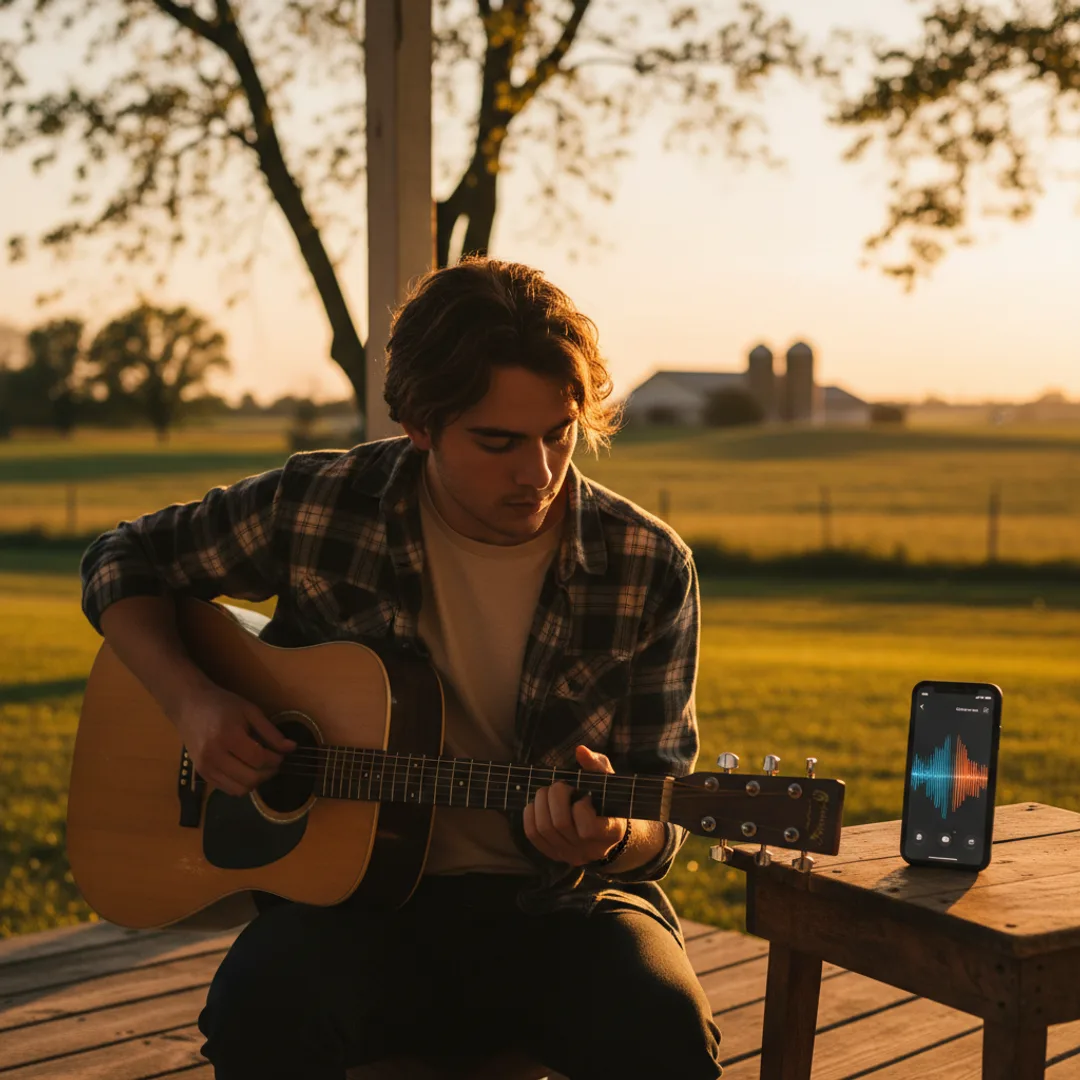
AI Country Song Generator: Modern Nashville Style
Generate a Nashville-grade country song with AI on iPhone — modern country pop, traditional acoustic, country rock, honky-tonk. Prompt templates that hit Music Row standards in under five minutes.
I spent a week last March in a co-working space three doors down from a working Nashville studio. Half the people in the coffee shop were songwriters; the other half were producers. Country in 2026 has split into roughly six recognizable subgenres, each with its own production conventions, its own tempo conventions, and its own lyrical conventions. A modern Morgan Wallen country-pop track and a traditional Tyler Childers acoustic ballad are barely the same genre. Most AI music apps default to a kind of generic country sound that splits the difference and lands in neither subgenre cleanly.
This is the case for narrow AI country prompting that I have been working out across about thirty test generations. Country music has tighter conventions than almost any other modern popular genre — instrumentation, lyric structure, vocal delivery, mastering, all evolved separately within each subgenre. Generic "country" prompts produce songs that sound vaguely country to non-country listeners but read as off to actual country fans. Subgenre-specific prompts produce songs that pass for Music Row demos.
This guide is the workflow I have refined for generating modern country songs on iPhone — Nashville pop country, traditional acoustic country, country rock, honky-tonk, Americana, and Texas country — in under five minutes per track. The prompt templates that hit each subgenre's conventions, the lyric structures that actually sound country, and where AI is already on demo-quality footing versus where it still needs a human pass.
Why generic AI country songs sound off to actual country fans
A few specifics about country music in 2026 that most non-country listeners never quite work out:
Country is six subgenres, not one. Modern Nashville country pop (Morgan Wallen, Luke Combs, Bailey Zimmerman), traditional acoustic country (Tyler Childers, Zach Bryan), country rock (Eric Church, Jelly Roll), honky-tonk and outlaw (Cody Jinks, Colter Wall), Americana folk (Sturgill Simpson, Jason Isbell), Texas red dirt (Turnpike Troubadours, Charley Crockett). Each has its own production identity. A prompt that says only "country" produces a generic blend that fits none of them.
The instrumentation conventions are tight. Pop country has electronic drums, layered electric guitars, and pop vocal production. Traditional acoustic country has fingerpicked guitar, fiddle, mandolin, dobro, and almost no synthetic instruments. Honky-tonk has shuffle drums, walking bass, pedal steel, and Telecaster twang. Naming the right instruments in the prompt is the single biggest lever.
Country lyric structure is specific. Country songs lean on concrete imagery — specific places, specific objects, specific small actions. "Six o'clock cigarette on the back porch in October" is a country line. "You make me feel alive" is a pop line. AI music apps can write either, but the country lyric structure has to be prompted explicitly.
Vocal delivery is the second biggest tell. Modern Nashville pop country uses a smooth, dynamic-range-controlled male vocal. Traditional country uses a more conversational, slightly twanged delivery. Outlaw country uses a low-register growl. Specifying the vocal delivery style separates demo-grade country from generic country.
For the broader prompt-craft foundation, how to write AI song prompts that actually produce great music is the most useful companion read.
What AI country music gets right — and what it still gets wrong

AI music apps in 2026 handle country at varying levels of competence depending on the subgenre. Honest accounting of where the technology lands.
Gets right consistently:
- Modern Nashville pop country. The four-on-the-floor kick, the layered electric guitars, the smooth pop vocal — all converge cleanly because the production conventions overlap with mainstream pop. AI music apps produce demo-grade Nashville pop country on the second or third generation.
- Acoustic country ballads. Fingerpicked guitar, soft vocals, sparse arrangement — these are achievable on most AI music apps because the texture is straightforward.
- Country pop with sung lead and key changes. Bridge sections and final-chorus key changes are well-handled across most apps.
- Lyric writing in the country idiom — with prompting. When the lyrics field is given country-appropriate imagery (small towns, trucks, porches, specific times of day, weather), the AI writes within the conventions.
Still gets wrong or inconsistent:
- True pedal steel guitar. The smooth bending and sustained chord swells of pedal steel are difficult for current AI music models. Tracks prompted for pedal steel often produce an approximation that does not pass to country listeners. Real pedal steel needs a real player.
- Honky-tonk shuffle rhythm. The triplet-feel shuffle of classic honky-tonk is rhythmically subtle and current AI music apps tend to default to straight-eighth or sixteenth notes. Achievable but requires explicit prompting and three to five iterations.
- Twangy Telecaster lead guitar. The specific tone of a Telecaster through a clean amp with light spring reverb — the foundational sound of country lead guitar — is reproducible but not consistent.
- Distinctive country vocal yodels and breaks. The vocal flourishes of traditional country (yodel breaks, vocal cracks, conversational asides) are not yet a strong suit of AI vocal generation.
- Fiddle solos with bow articulation. Fast fiddle solos with bowing technique are recognizable but tend toward synthesized-violin texture.
For more on AI music quality across genres, the best AI music app for iPhone 2026 ranking covers what each major app handles best.
Step-by-step: a modern Nashville country track in Muziko
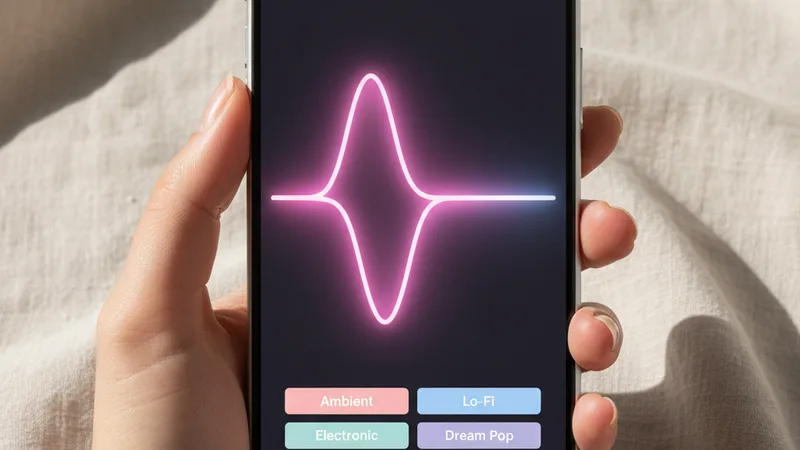
The workflow I have used for ten test country tracks. Total time on the most recent run was 4 minutes 52 seconds from opening the app to having a deliverable track.
1. Open Muziko and tap Create. Switch to Write Lyrics mode if you want a vocal country track with specific lyrics; switch to Describe mode for instrumental country tracks (background music, score, intro music).
2. Pick the genre tag. Pick Country if the app offers it; otherwise pick the closest tag (often Folk or Americana). The genre tag is the AI's anchor — it routes the model toward country-appropriate instrumentation and conventions.
3. Pick a mood. Sentimental for heartbreak songs and reflective ballads. Confident for upbeat trucking and "good times" songs. Playful for honky-tonk and dance-oriented tracks. Dreamy for Americana folk crossovers.
4. Specify the country subgenre in the prompt explicitly. "Modern Nashville pop country in the style of mainstream 2026 country radio" or "traditional acoustic country in the style of singer-songwriter Americana" or "honky-tonk shuffle with pedal steel and Telecaster lead." The subgenre direction is the single biggest lever.
5. Name the instruments. "Acoustic guitar, electric guitar with light overdrive, mandolin on the second verse, fiddle solo on the bridge, brushed snare drums, walking bass, light pedal steel pad on the choruses, no synthetic instruments" for traditional. "Layered electric guitars, programmed kick drum, pop-style bass, light synth pad, modern pop vocal production" for pop country.
6. Write country-appropriate lyrics. Concrete imagery beats abstract sentiment. Small towns, specific times of day, specific weather, specific objects (trucks, jeans, porches, dirt roads, water towers, churches). Country uses simple rhyme schemes — AABB or ABAB. Six to ten lines is enough for a verse-chorus structure.
7. Set the tempo. 70-85 bpm for ballads. 88-105 bpm for mid-tempo. 110-130 bpm for upbeat pop country. 90-110 bpm for honky-tonk shuffle. Country tempos are tighter than pop tempos — overshoot by 5 bpm and the song starts sounding like dance pop.
8. Generate three to five takes and listen on a real speaker. Country mixes need to survive a truck radio. Listen on Bluetooth speakers or car speakers, not just headphones — that is where country songs actually live.
For the full mobile workflow walkthrough, the AI song generator for iPhone 2026 guide covers each creation mode in depth.
Writing a country prompt that hits Music Row conventions

A working country prompt has seven small ingredients. Miss any one and the track lands in the "vague country" valley rather than a specific subgenre.
The subgenre, named explicitly. "Modern Nashville pop country" or "traditional acoustic country" or "honky-tonk shuffle" or "Texas red dirt country" or "Americana folk." Each routes the AI toward different instrumentation defaults.
The tempo, as a number tied to the subgenre. Pop country at 118 bpm. Traditional ballad at 78 bpm. Honky-tonk shuffle at 102 bpm. Texas red dirt at 95 bpm. Americana folk at 88 bpm. Match the tempo to the subgenre conventions.
The instrumentation, narrow and named. "Acoustic guitar fingerpicked on the verses, light electric guitar with clean Telecaster tone on the choruses, brushed snare drums, walking upright bass, fiddle on the bridge" is a usable prompt. "Country instruments" produces vague results.
The vocal direction, subgenre-matched. "Solo male vocal, warm modern pop country delivery, smooth and clear, vocal slightly forward in the mix, light reverb" for pop country. "Solo male vocal, conversational delivery with light Southern accent, slight twang on emphasized words" for traditional country. The vocal style is the second biggest tell after instrumentation.
Concrete lyric imagery. Reference real things — "the truck on the dirt road, the porch light on at 9 pm, the church on Main Street, the September fog over the lake." Avoid abstract sentiment without concrete anchors.
A bridge or key change structure for pop country. "Modulation up one whole step at the start of the final chorus, fiddle and pedal steel entering on the modulation" gives the AI a structural map for the build that defines pop country.
Country mastering. "Mastered for country radio playback, warm midrange, prominent vocal, controlled low end, light tape compression character." This separates Nashville country from indie acoustic.
A combined working prompt for modern Nashville pop country:
"Modern Nashville pop country song for a heartbreak summer track, 110 bpm, sentimental and confident, solo male vocal warm and clear with smooth modern pop country delivery and slight Southern accent, layered electric guitars with clean Telecaster lead, fingerpicked acoustic guitar on the verses, programmed kick drum and pop-style bass, light pedal steel pad on the choruses, fiddle line entering on the bridge, modulation up one whole step at the start of the final chorus, lyrics about a summer that ended on the back porch in October with a six o'clock cigarette and a phone that never lit up again, two minutes forty seconds, mastered for country radio with warm midrange and prominent vocal."
In testing, that prompt produces a Nashville-demo-grade pop country track in roughly three to four generations about 80% of the time. For more on iterating prompts, the perfect prompts breakdown covers the underlying patterns.
Matching country subgenre to production conventions: a starter chart
Country music is genre-tight in a way most other modern genres are not. Pick the right subgenre and the conventions follow. Patterns that consistently hold:
| Subgenre | Tempo | Instrumentation | Vocal | Production |
|---|---|---|---|---|
| Modern Nashville pop country | 100-128 bpm | Layered electric guitars, programmed drums, pop bass, light pedal steel | Smooth modern pop delivery, slight Southern accent | Bright, controlled dynamics, prominent vocal |
| Traditional acoustic country | 70-95 bpm | Fingerpicked acoustic, fiddle, mandolin, dobro, brushed drums | Conversational with light twang | Warm, organic, room-tone, light tape character |
| Country rock | 95-125 bpm | Electric guitars with overdrive, full drums, electric bass, occasional pedal steel | Confident rock delivery with country phrasing | Big drums, distorted guitars, modern rock mix |
| Honky-tonk / outlaw | 95-115 bpm | Telecaster lead, walking bass, shuffle drums, pedal steel, fiddle | Conversational with stronger twang, sometimes growl | Dry, mid-forward, slight tape saturation |
| Americana / folk | 75-100 bpm | Acoustic guitar, banjo, mandolin, harmonica, brushed drums | Singer-songwriter conversational | Warm, room-tone, minimal compression |
| Texas red dirt | 90-115 bpm | Acoustic + light electric, fiddle, brushed drums, harmonica | Conversational, slight Texas drawl | Warm, mid-prominent, slight room sound |
| Country trap / hick-hop | 85-105 bpm | 808 bass with country acoustic instruments, programmed drums | Rap delivery with country phrasing | Modern hip-hop production with country textures |
| Country ballad (any subgenre) | 60-78 bpm | Acoustic guitar with strings or pedal steel pad | Restrained, emotional, conversational | Warm, narrow dynamic range, prominent vocal |
Pick the row that matches what you want. Lock the tempo. Layer the genre-specific instrumentation and vocal direction on top. For related genre work, the AI hip-hop guide covers the country trap crossover from the hip-hop side, and the lo-fi guide covers acoustic textures that overlap with Americana.
When AI country works — and when to bring in a real player

Honest accounting of where AI country is the right tool and where it should be a starting point that a human player finishes.
Works:
- Demo tracks for songwriters pitching to Nashville publishers. AI-generated country tracks are now at demo quality on pop country and acoustic subgenres. Songwriters who used to spend $400-800 per demo can generate the demo on iPhone in five minutes.
- Custom personal country songs for gifts and personal events. Birthdays, anniversaries, memorial services, wedding first dances — when the recipient is a country fan, an AI country track lands harder than a generic pop track.
- Indie game and YouTube content needing country background music. Royalty-free country libraries are shallow. AI fills the niche-specific gap, especially for honky-tonk, Americana, and Texas red dirt subgenres that royalty-free libraries underweight.
- Country songwriters experimenting with new directions. Generating an AI track in an adjacent subgenre — a pop country writer trying Americana, an Americana writer trying country rock — is a low-cost way to explore.
- Singer-songwriters building song catalogs for sync licensing. Sync licensing buyers (film, TV, advertising) want a wide range of demos to choose from. AI lets songwriters cover more subgenres than they could otherwise demo personally.
Bring in a real player:
- For real pedal steel. The specific tone, sustain, and bending of pedal steel guitar is not yet AI's strongest area. Demos can use AI; finished commercial releases benefit from a real pedal steel player ($150-400 per song typically).
- For traditional fiddle solos. Bowing articulation on country fiddle is recognizable. AI generates plausible fiddle parts but they read as synthesized to fiddle players. Live fiddle ($100-300 per song) closes the gap.
- For Nashville session-quality electric lead guitar. The specific tonal vocabulary of Nashville session players (clean Telecaster, hybrid picking, country bends) is achievable in AI but inconsistent. For polished releases, live session work still wins.
- For finished commercial country releases on major labels. Major-label country releases have production conventions and quality bars that AI does not yet consistently meet. AI is a demo and pre-production tool in this context, not a finished-track replacement.
- When the song will be performed live. A track designed to be performed live should be written for the actual instruments the live band has. AI demos can guide the songwriting but the production should reflect the live setup.
For the broader licensing context for commercial country music releases, the can you sell AI-generated music legal guide covers the rights and disclosure questions.
Try this prompt right now
Open Muziko on iPhone, tap Create, switch to Write Lyrics, pick Country genre and Sentimental mood, and paste these lyrics (adjust the specific imagery to fit your song):
"Six o'clock cigarette on the back porch in October, truck still warm from the drive home from Macon, the church on Main Street already dark, the porch light on at nine like my mother always taught me, and the phone that never lit up again, and the long quiet road back to who I used to be."
Add the prompt note: "Modern Nashville pop country, 110 bpm, sentimental and confident, solo male vocal warm and clear with smooth modern pop country delivery and slight Southern accent, layered electric guitars with clean Telecaster lead, fingerpicked acoustic guitar on the verses, programmed kick drum and pop-style bass, light pedal steel pad on the choruses, fiddle line entering on the bridge, modulation up one whole step at the start of the final chorus, two minutes forty seconds, mastered for country radio with warm midrange and prominent vocal."
Generate three to five takes. Listen through Bluetooth speakers or a car stereo, not just headphones — country mixes need to survive a real truck radio test. Pick the take where the vocal sits cleanly forward, the Telecaster lead has the right brightness, and the modulation in the final chorus lands cleanly. Save in the highest-quality format your app offers.
In testing, this template produces a Nashville-demo-grade pop country track in roughly four total generations about 80% of the time. For other genre how-tos in the same workflow style, the AI rap generator guide and the AI EDM generator guide cover the equivalent prompting craft for their respective genres.
Frequently asked questions
Can AI really make country songs that sound like Nashville?
Modern Nashville pop country, yes — AI music apps in 2026 produce demo-grade pop country on the second or third generation when the prompt names the subgenre, instrumentation, vocal style, and tempo specifically. Traditional acoustic country and Americana also work well. Honky-tonk shuffle and outlaw country are harder because of rhythm subtleties and pedal steel tone, but achievable with three to five iterations. The single biggest factor is naming the specific subgenre in the prompt rather than just saying "country" — generic country prompts produce vaguely country tracks that read as off to actual country fans.
How do I get the AI to write country-style lyrics?
Write the lyrics yourself with concrete country-appropriate imagery, and put them in the Write Lyrics field. Reference real things — small towns, specific times of day, specific weather, trucks, dirt roads, porches, water towers, churches, jeans, boots. Avoid abstract sentiment without concrete anchors. Country uses simple rhyme schemes (AABB or ABAB) and direct emotional language rather than poetic metaphor. A line like "six o'clock cigarette on the back porch in October" is more country than "the feelings I carry inside me." If you let the AI write the lyrics from a vague prompt, you get pop lyrics with country instruments — which sounds wrong.
Which country subgenre is easiest to generate with AI?
Modern Nashville pop country is the easiest because its production conventions overlap with mainstream pop — electric guitars, programmed drums, smooth vocal production, key changes in the final chorus. Most AI music apps in 2026 produce demo-grade pop country on the second or third generation. Acoustic country ballads are second easiest — fingerpicked guitar, sparse arrangement, conversational vocal. The hardest subgenres are honky-tonk shuffle (rhythmically subtle), traditional outlaw country (vocal delivery), and any subgenre that depends heavily on real pedal steel guitar. For those, AI is a starting point that benefits from a real player to finish.
Can I use AI country songs for commercial releases on Spotify and Apple Music?
Yes, when generated on the paid tier of a reputable AI music app like Muziko Pro at $34.99 per year, Suno Pro, or Udio Pro. The paid tier grants commercial usage rights including release on Spotify, Apple Music, YouTube Music, and Amazon Music through distribution services like DistroKid or TuneCore. Disclose AI use where required — most distribution services in 2026 ask for AI content disclosure. Free-tier generations are not licensed for commercial release. Never prompt the AI to imitate a specific living artist's voice or style; stay generic with genre and instrument directions to avoid both legal and platform-policy issues.
What's the right tempo for different country subgenres?
Tempo conventions are tighter in country than in most modern genres. Country ballads run 60-78 bpm. Traditional acoustic country runs 70-95 bpm. Texas red dirt and Americana run 90-110 bpm. Honky-tonk shuffle runs 95-115 bpm. Modern Nashville pop country runs 100-128 bpm. Country rock runs 95-125 bpm. Going more than 5 bpm above the genre convention tends to push the track toward dance pop or rock. Going more than 5 bpm below tends to push it toward folk or singer-songwriter. Match the BPM to the subgenre and the track lands in the right space.
Should I use AI country songs in my songwriter demos for Nashville publishers?
Yes for pop country and acoustic country subgenres — AI tracks are at demo quality and the cost-time math is decisive ($400-800 saved per demo, 5 minutes versus 2 weeks). For honky-tonk, outlaw country, and tracks that depend heavily on pedal steel or live fiddle, AI works for early-stage demos that demonstrate the song idea, but publishers expect more polished demos for serious pitches. Many Nashville songwriters use AI for the first 10-15 demo tracks of a new catalog, then bring in real session players for the songs that gain traction with publishers. Always disclose AI use when submitting demos — most publishers ask, and hiding it can damage relationships.
Try everything you just read about. Muziko is free to download.
![AI Amapiano Generator: Log Drum Tracks [Tested 2026]](/_next/image?url=%2Fimages%2Fblog%2Fai-amapiano-generator-log-drum-tracks%2Fhero.webp&w=3840&q=75)
![AI Cinematic Music Generator: Trailer Scores [Tested]](/_next/image?url=%2Fimages%2Fblog%2Fai-cinematic-music-generator-trailer-scores%2Fhero.webp&w=3840&q=75)