
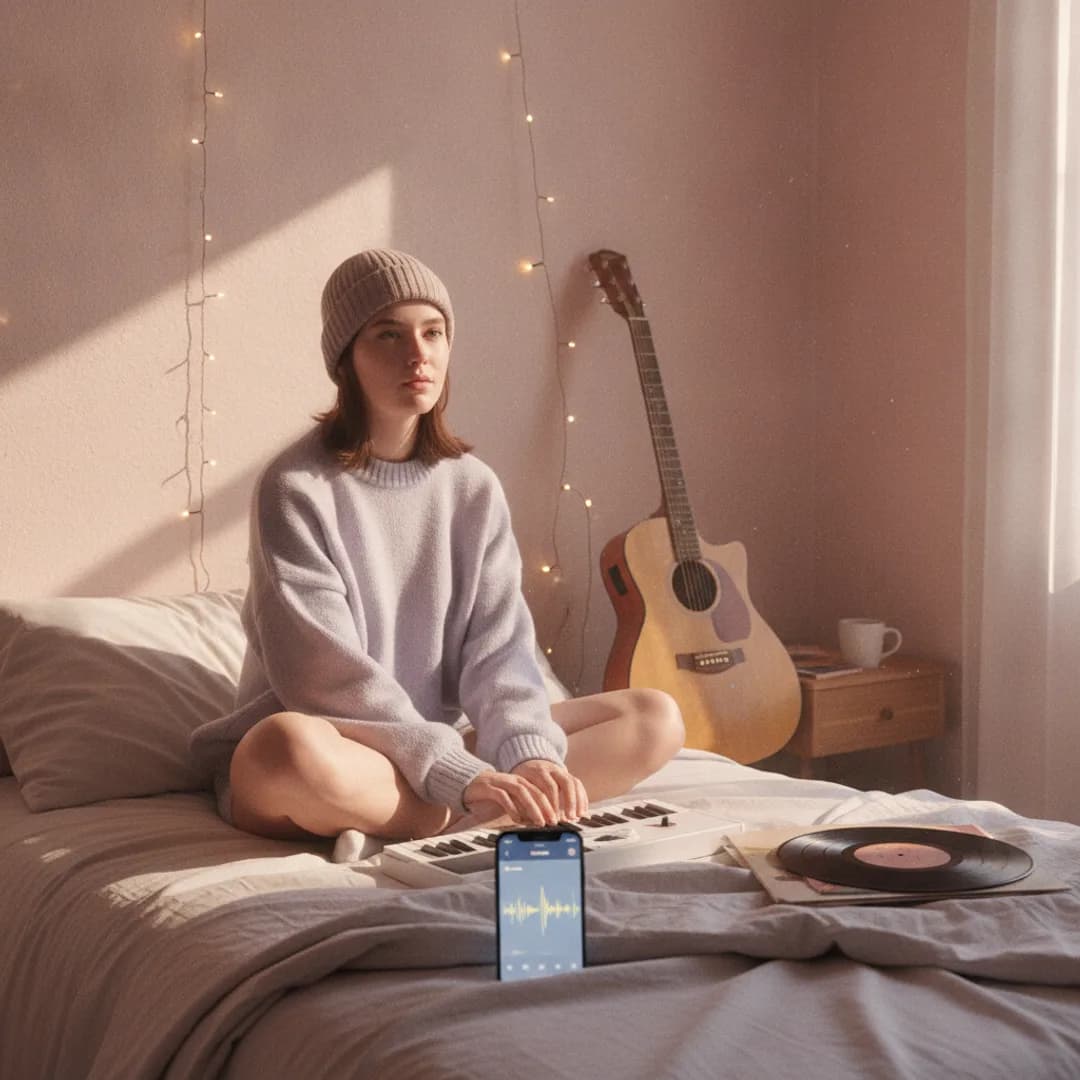
AI Bedroom Pop Generator: Lo-fi Indie That Feels Real
Generate bedroom pop with AI on iPhone — lo-fi indie aesthetic, intimate vocals, soft synths, 95-115 BPM. Real bedroom pop that doesn't sound overproduced, in 5 minutes.
Bedroom pop is the genre that resists AI generation the most quietly. The defining trait of the genre — that it sounds like a 19-year-old recorded it alone in their bedroom on a USB mic with a single MIDI keyboard and a slightly broken acoustic guitar — is exactly the kind of artistic constraint that makes AI-generated bedroom pop feel wrong by default. AI music apps in 2026 want to produce polished, mixed, mastered tracks. Bedroom pop wants to sound a little broken, a little intimate, a little tape-hiss-and-window-noise. The fix is prompting for the imperfections explicitly — the lo-fi degradation, the slightly-out-of-tune Casio, the intimate close-mic vocal that isn't quite pitch-corrected, the soft tape compression that flattens the high end.
This is the case for narrow bedroom pop prompting that I've tested across about thirty generations. Generic "indie pop" prompts produce indie-pop-adjacent tracks that read as too clean for the genre. Specific bedroom pop prompts — with explicit direction toward intimate vocals, lo-fi production, soft synth pads, and the deliberate imperfections that define the aesthetic — produce tracks that actually sit in the genre alongside Clairo, Boy Pablo, Beabadoobee, Cuco, and the broader bedroom-pop scene. The genre is built on artistic restraint; the AI prompting has to follow that restraint or the track betrays itself.
This guide is the workflow for generating bedroom pop on iPhone — classic bedroom pop, dream pop crossover, lo-fi indie, hyper-intimate pop, surf-bedroom pop — in under five minutes per track. The prompt templates that hit the aesthetic and the honest limits of bedroom pop generation in 2026.
Why generic indie pop prompts produce overproduced tracks
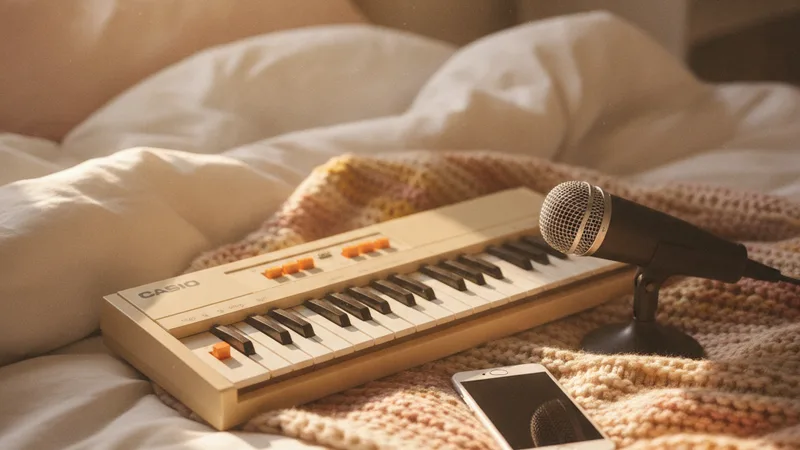
A few specifics about bedroom pop that almost no non-bedroom-pop listener fully thinks about.
The genre's defining trait is intentional imperfection. Bedroom pop is deliberately lo-fi. The slightly off-tune keys, the tape hiss, the unmixed-feeling vocal sitting too close to the mic, the kick drum that's slightly too quiet — these aren't accidents. They're the genre's artistic identity. AI music apps default to polishing all of these out, which produces overproduced tracks that miss the genre entirely.
The vocal needs to feel like the artist is sitting next to you, not on a stage. Bedroom pop vocals are close-miked, often slightly breathy, frequently slightly pitchy, and almost never heavily autotuned. The intimacy comes from sounding like an unfinished demo. AI defaults to pitch-corrected, processed vocals; the fix is "intimate close-miked vocal that sounds like a USB microphone recording in a small room, slight breath audible, no autotune, no professional vocal compression."
The synth pads are soft and slightly out of tune. Bedroom pop synth pads use vintage Casio, Yamaha, or Korg sounds rather than modern polished synth presets. They're slightly detuned. They have audible tape character. They sit in the background rather than the foreground. Prompt "soft slightly-detuned vintage Casio-style synth pad, gentle tape character, sits in the background of the mix."
Tempos are mid-range and unhurried. Bedroom pop sits at 95-115 BPM, slower than modern indie pop. The slower tempos contribute to the unhurried, intimate feel.
Drums are programmed lightly or replaced with rim shots and finger taps. Real bedroom pop often has minimal drums — a programmed kick on the one and three, a rim shot or finger snap on the two and four, no full drum kit. Prompt "minimal drum programming with light kick on one and three, rim shot or finger snap on two and four, no full drum kit, soft and unhurried rhythmic feel."
The mastering is intentionally soft and tape-warmed. Bedroom pop tracks are mastered low — not the loud streaming standard. They feel like a cassette tape rather than a streaming hit. Prompt "soft tape-warmed mastering with controlled high frequencies, low overall loudness, audible tape hiss, no compression-pumping, no loudness-war mastering."
For the foundational prompt-craft, how to write AI song prompts that actually produce great music is the most useful companion read. For the closely adjacent lo-fi workflow, see the AI lo-fi guide.
What AI bedroom pop gets right — and what it still misses
Honest accounting of where AI bedroom pop lands.
Gets right consistently:
- The core bedroom pop aesthetic. Lo-fi instrumentation, vintage synth pads, intimate vocals, minimal drums — produces well on the second or third generation when prompted explicitly.
- Dream pop crossover. The atmospheric dream-pop-meets-bedroom-pop territory handles cleanly.
- Surf-bedroom pop. The Mac DeMarco / Boy Pablo surf-tinged subgenre with reverby clean electric guitar produces well.
- Lo-fi indie ballads. The slower, more intimate side of the genre at 90-105 BPM lands consistently.
- Bedroom pop with light electronic elements. The Clairo-adjacent territory with subtle synth pads and minimal drums works.
Still misses or inconsistent:
- The specific lo-fi degradation that defines named producers. AI produces lo-fi-aesthetic tracks; it doesn't produce the specific lo-fi signatures of individual bedroom pop producers, which is appropriate.
- Hyper-intimate vocal performances. The specific intimacy of artists like Phoebe Bridgers or Lucy Dacus comes from authentic emotional performance AI doesn't replicate.
- The unmixed-feeling production. AI music apps produce mixes that are slightly too polished even when prompted for lo-fi. Real bedroom pop has a quality of feeling like it wasn't fully mixed; AI tends to apply mix logic that fights this aesthetic.
- Region-specific bedroom pop scenes. The Manila bedroom pop scene, the Mexican bedroom pop scene, the UK bedroom pop scene all have specific micro-conventions AI tends to homogenize.
- Songs that feel autobiographical. Bedroom pop often feels first-person and confessional. AI lyrics tend toward universal-pop patterns rather than the specific autobiographical detail that defines great bedroom pop lyrics. The fix is writing the lyrics yourself or with ChatGPT first.
For more on AI music quality across genres, the best AI music app for iPhone 2026 ranking covers what each major app handles best.
Step-by-step: a bedroom pop track in Muziko
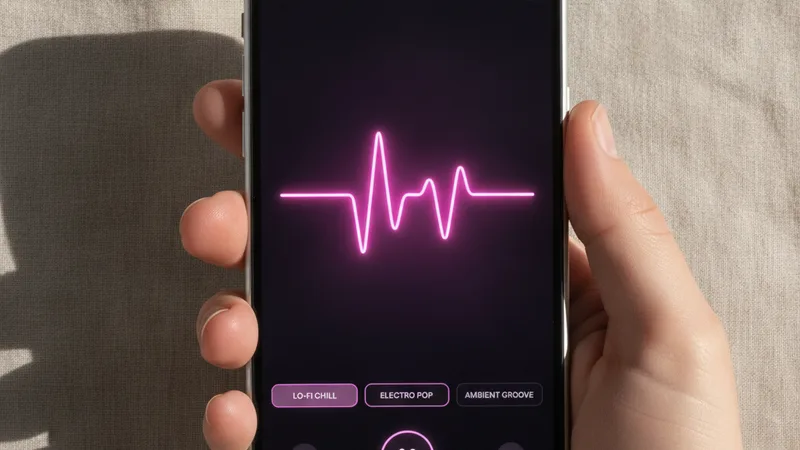
The workflow. Total time on a successful bedroom pop run averages 4-5 minutes.
1. Open Muziko on iPhone or iPad. Switch to Write Lyrics mode for vocal bedroom pop, Describe mode for instrumental.
2. Pick the genre tag. Pick Indie Pop or Lo-fi. Bedroom pop sits between the two — the genre direction in the prompt does the work of pulling toward bedroom pop specifically.
3. Pick a mood. Dreamy + sentimental is the default for most bedroom pop. Dreamy + playful for the more upbeat side (Boy Pablo, Cuco). Sentimental + reflective for the more confessional side (Clairo, Phoebe Bridgers crossover).
4. Lead with the intimacy direction. "Bedroom pop track at 102 BPM, dreamy sentimental mood, intimate close-miked vocal that sounds like a USB microphone recording in a small room, slight breath audible, no autotune, no professional vocal compression."
5. Specify the lo-fi instrumentation. "Soft slightly-detuned vintage Casio-style synth pad in the background, finger-picked acoustic guitar with audible string noise, clean reverby electric guitar with surf-style spring reverb on the chorus, soft warm fingered bass."
6. Specify minimal drums. "Minimal drum programming with light kick on one and three, rim shot or finger snap on two and four, no full drum kit, soft and unhurried rhythmic feel, no high-energy drums."
7. Add lo-fi character. "Audible tape hiss throughout, vinyl crackle on the verses, slight tape wow and flutter on the synth pads, intentional lo-fi degradation."
8. Mastering for bedroom pop. "Soft tape-warmed mastering with controlled high frequencies, low overall loudness, audible tape hiss, no compression-pumping, no loudness-war mastering, mastered for headphone intimate listening rather than streaming-standard loudness."
9. Length. Bedroom pop works at 2:30-3:30. Generate at 2:45 for most use cases.
10. Generate four to six takes. Listen on quality headphones — bedroom pop lives or dies on the intimate close-miked feel, which laptop speakers hide. Pick the take with the most intimate vocal, the softest production, and the most authentic lo-fi character.
For the full mobile workflow, the AI song generator for iPhone 2026 guide covers each creation mode in depth.
Writing the bedroom pop prompt
A working bedroom pop prompt has seven ingredients. Miss any one and the track lands as overproduced indie pop rather than as real bedroom pop.
The intimacy direction up front. "Intimate close-miked vocal that sounds like a USB microphone recording in a small room" leads the prompt. The intimacy is the genre's defining trait; lead with it.
No autotune, no heavy vocal processing. "No autotune, no professional vocal compression, slight pitchy moments preserved rather than corrected, breathy intimate delivery."
Vintage synth direction. "Soft slightly-detuned vintage Casio-style synth pad, gentle tape character, sits in the background rather than the foreground."
Minimal drum programming. "Minimal drum programming with light kick on one and three, rim shot or finger snap on two and four, no full drum kit, soft and unhurried rhythmic feel."
Lo-fi character. "Audible tape hiss throughout, vinyl crackle on the verses, slight tape wow and flutter on the synth pads, intentional lo-fi degradation."
Soft mastering. "Soft tape-warmed mastering with controlled high frequencies, low overall loudness, audible tape hiss, no compression-pumping, no loudness-war mastering."
Length and structure. 2:30-3:30 typical, verse-chorus-verse-chorus structure usually sufficient — bedroom pop doesn't need elaborate structure.
A combined working prompt for a contemporary bedroom pop track:
"Contemporary bedroom pop track at 102 BPM, dreamy sentimental mood, intimate close-miked vocal that sounds like a USB microphone recording in a small room with slight breath audible, no autotune and no professional vocal compression, slight pitchy moments preserved rather than corrected, soft slightly-detuned vintage Casio-style synth pad in the background, finger-picked acoustic guitar with audible string noise, clean reverby electric guitar with surf-style spring reverb on the chorus, soft warm fingered bass, minimal drum programming with light kick on one and three and finger snap on two and four, audible tape hiss throughout, vinyl crackle on the verses, slight tape wow and flutter on the synth pads, two minutes forty-five seconds, soft tape-warmed mastering with controlled high frequencies, low overall loudness, no loudness-war mastering, mastered for headphone intimate listening."
In testing, that prompt produces a bedroom pop-grade track in roughly three generations about 80% of the time. For prompt iteration craft, the perfect prompts breakdown covers the underlying patterns.
Matching bedroom pop subgenre to production conventions
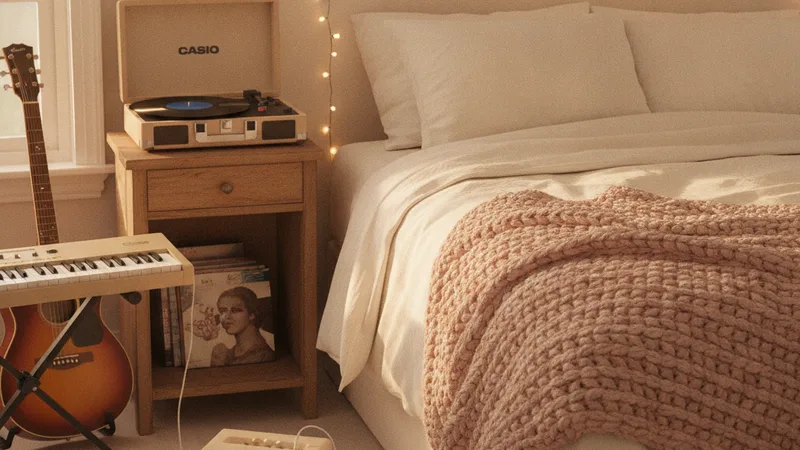
Bedroom pop subgenres differ on instrumentation, vocal style, lo-fi character, and overall mood.
| Subgenre | Tempo | Lead instrument | Vocal style | Mood |
|---|---|---|---|---|
| Classic bedroom pop (2018-2026 era) | 95-110 BPM | Casio synth + acoustic | Intimate close-miked | Dreamy + sentimental |
| Surf-bedroom pop (Mac DeMarco era) | 100-115 BPM | Clean reverby electric guitar | Breathy intimate | Dreamy + playful |
| Lo-fi indie ballad | 80-95 BPM | Finger-picked acoustic | Confessional intimate | Sentimental + reflective |
| Dream pop crossover | 95-110 BPM | Atmospheric synth pad | Reverberant breathy | Dreamy |
| Hyper-intimate confessional | 75-95 BPM | Solo guitar or piano | Whispered close-miked | Sentimental |
| Bedroom pop with electronic | 100-115 BPM | Casio + light beat | Intimate with light processing | Dreamy + playful |
| Bedroom pop x indie folk | 95-105 BPM | Acoustic + light strings | Intimate folk-influenced | Sentimental |
| Manila bedroom pop | 95-110 BPM | Casio + clean electric | Tagalog-influenced intimate | Dreamy + sentimental |
| Mexican bedroom pop (Cuco era) | 100-115 BPM | Casio + Spanish-influenced | Bilingual intimate | Dreamy + playful |
| UK bedroom pop | 95-110 BPM | Casio + jangly electric | British intimate | Dreamy + sentimental |
| Bedroom pop x hyperpop hybrid | 110-130 BPM | Casio + light glitch | Intimate with subtle processing | Playful + dreamy |
| Lo-fi study bedroom pop | 80-95 BPM | Soft Rhodes + light beats | Hummed intimate | Dreamy |
| Bedroom pop x R&B | 80-95 BPM | Rhodes + lo-fi drums | Soulful intimate | Sentimental |
| Bedroom pop x country | 95-110 BPM | Acoustic + harmonica | Country-influenced intimate | Sentimental |
Pick the row matching what you want. For related genre work, see the AI lo-fi guide, AI R&B generator guide, AI country song guide, and AI hyperpop guide.
When AI bedroom pop works — and the limits
Honest accounting.
Works:
- TikTok and Instagram Reels background music for indie-aesthetic content, lifestyle vlogs, slow-mo edits.
- Songwriter demos for indie pop and bedroom pop songwriters exploring the genre direction.
- Indie game and content creator background music for bedroom-pop-aesthetic visual content.
- Personal-occasion songs in bedroom pop style for partners who listen to Clairo / Boy Pablo / Beabadoobee.
- Coffee shop and lifestyle business background music.
Falls short:
- Serious bedroom pop artist releases for the bedroom pop audience. The bedroom pop scene values authentic personal voice. AI tracks released as serious artist work will receive critical scrutiny because the genre's defining trait is autobiographical authenticity.
- Prompts that imitate specific living bedroom pop artists. "In the style of Clairo" or "in the style of Beabadoobee" prompts are prohibited in commercial AI music apps. Stay generic.
- Authentic confessional lyrics. Bedroom pop lyrics that work are usually first-person autobiographical. AI-generated lyrics tend toward universal pop patterns. Write the lyrics yourself or with ChatGPT for serious releases.
- The specific lo-fi production signatures. Real bedroom pop producers have specific lo-fi techniques that AI approximates but doesn't replicate.
For the broader licensing context, the can you sell AI-generated music legal guide covers commercial release questions.
Try the prompt now
Open Muziko on iPhone, switch to Describe mode, pick Lo-fi or Indie Pop genre and Dreamy mood, and paste:
"Contemporary bedroom pop track at 102 BPM, dreamy sentimental mood, intimate close-miked vocal that sounds like a USB microphone recording in a small room with slight breath audible, no autotune and no professional vocal compression, slight pitchy moments preserved rather than corrected, soft slightly-detuned vintage Casio-style synth pad in the background, finger-picked acoustic guitar with audible string noise, clean reverby electric guitar with surf-style spring reverb on the chorus, soft warm fingered bass, minimal drum programming with light kick on one and three and finger snap on two and four, audible tape hiss throughout, vinyl crackle on the verses, slight tape wow and flutter on the synth pads, two minutes forty-five seconds, soft tape-warmed mastering with controlled high frequencies, low overall loudness, no loudness-war mastering, mastered for headphone intimate listening."
Generate four to six takes. Listen on quality headphones. Pick the take with the most intimate close-miked vocal feel, the softest production, and the most authentic lo-fi character.
For related genre how-tos, see the AI lo-fi guide, AI R&B generator guide, AI hyperpop guide, and AI country song guide.
Frequently asked questions
Can AI really generate bedroom pop that doesn't sound overproduced?
Yes, when prompted explicitly for the intentional imperfections that define the genre. AI music apps in 2026 default to polished mixes and pitch-corrected vocals — the opposite of what bedroom pop wants. The fix is leading the prompt with "intimate close-miked vocal that sounds like a USB microphone recording in a small room, no autotune, no professional vocal compression, slight pitchy moments preserved rather than corrected." Add lo-fi character explicitly: "audible tape hiss throughout, vinyl crackle on the verses, slight tape wow and flutter." Specify soft tape-warmed mastering with low overall loudness. Get all three right and AI produces bedroom-pop-grade tracks. Generic "indie pop" prompts produce overproduced indie pop, not bedroom pop.
What BPM should bedroom pop be?
95-115 BPM is the bedroom pop range. Classic bedroom pop runs 95-110 BPM. Surf-bedroom pop (Mac DeMarco era) runs 100-115 BPM. Lo-fi indie ballads run 80-95 BPM. Dream pop crossover runs 95-110 BPM. Hyper-intimate confessional runs 75-95 BPM. The slower side of the genre (75-95 BPM) produces the more confessional, ballad-like tracks; the faster side (100-115 BPM) produces the more upbeat surf-leaning tracks. Match the BPM to the subgenre and prompt the exact number.
How do I get the intimate close-miked vocal right in AI bedroom pop?
Lead with it in the prompt and be explicit about what NOT to do. The phrase "intimate close-miked vocal that sounds like a USB microphone recording in a small room, slight breath audible, no autotune, no professional vocal compression, slight pitchy moments preserved rather than corrected, breathy intimate delivery" produces the right vocal aesthetic. The "NOT" directions matter as much as the affirmative ones — AI music apps default to pitch correction and vocal processing, so you have to explicitly tell them not to. Generate four to six takes and listen specifically for the closeness and breath audibility — that's the take that lands the bedroom pop aesthetic.
What's the difference between bedroom pop and lo-fi?
Lo-fi is a production aesthetic that applies across many genres — lo-fi hip-hop, lo-fi jazz, lo-fi house. Bedroom pop is a specific indie pop subgenre that uses lo-fi production as one of its defining traits. Bedroom pop has vocals (lo-fi often doesn't). Bedroom pop has more melodic content and song structure than ambient lo-fi study music. Bedroom pop is rooted in the indie pop tradition (Clairo, Boy Pablo, Beabadoobee, Cuco), while lo-fi study music is rooted in the hip-hop instrumental tradition. Use bedroom pop when you want vocal indie pop tracks with intimate lo-fi production. Use lo-fi when you want instrumental ambient background music for studying or working — see the AI lo-fi guide for that workflow.
Is it legal to release AI bedroom pop on Spotify and Bandcamp?
Yes, when generated on the paid tier of a reputable AI music app like Muziko Pro at $34.99 per year, Suno Pro, or Udio Pro. The paid tier grants commercial usage rights including release on Spotify, Apple Music, Bandcamp, and SoundCloud through distribution services like DistroKid or TuneCore. Disclose AI use where required — all major streaming platforms in 2026 ask for AI content disclosure on uploads. Never prompt the AI to imitate a specific living bedroom pop artist's style; the bedroom pop scene has well-known artists whose names should not appear in commercial prompts. Bandcamp specifically requires AI content disclosure as of 2026 and the bedroom pop audience on Bandcamp is particularly sensitive to authenticity — be ready for honest reactions if you release AI bedroom pop into that community, and consider whether your release framing honors the genre's autobiographical tradition.
Should I write the lyrics myself for bedroom pop?
Yes, especially for serious releases. Bedroom pop's defining lyric trait is first-person autobiographical specificity — Clairo writing about her actual experiences, Phoebe Bridgers writing about her actual losses, Boy Pablo writing about his actual relationships. AI-generated lyrics tend toward universal pop patterns rather than the specific autobiographical detail that defines great bedroom pop lyrics. For demo work and content creator background music, AI lyrics are acceptable. For artist releases meant for the bedroom pop audience, write the lyrics yourself, draft them in ChatGPT first with autobiographical seed material, or collaborate with another writer. The lyric quality matters more in bedroom pop than in almost any other genre because the audience comes to the genre specifically for the personal voice.
Try everything you just read about. Muziko is free to download.
![AI Cinematic Music Generator: Trailer Scores [Tested]](/_next/image?url=%2Fimages%2Fblog%2Fai-cinematic-music-generator-trailer-scores%2Fhero.webp&w=3840&q=75)
![AI Dubstep Generator: Drops That Actually Hit [Tested]](/_next/image?url=%2Fimages%2Fblog%2Fai-dubstep-generator-drops-that-hit%2Fhero.webp&w=3840&q=75)