AI Graduation Song Generator: Make a Custom Anthem
Skip the generic graduation playlist. Generate a custom AI graduation anthem on iPhone in under five minutes — their name, their school, the years that got them across the stage.
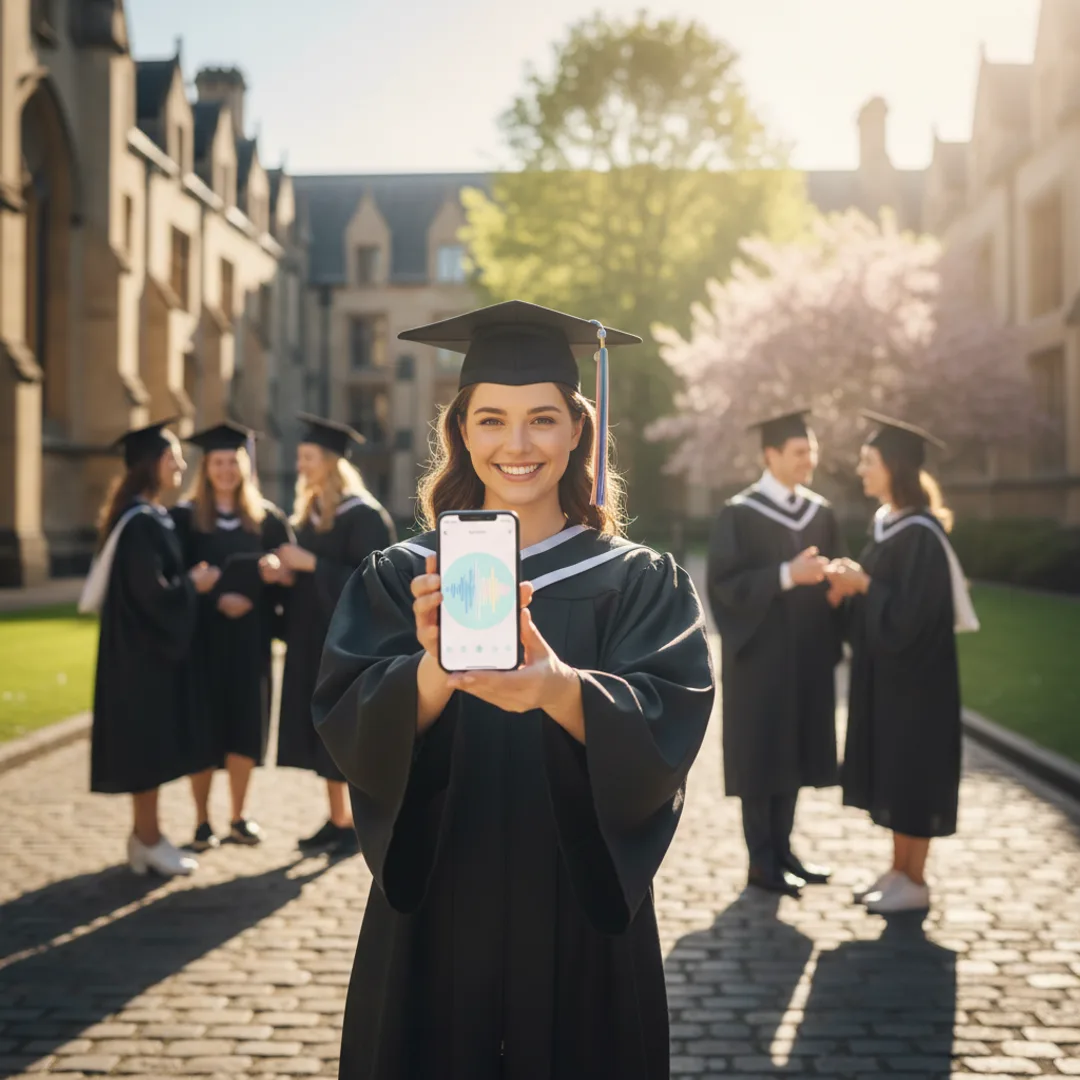
A friend's kid graduated from UCL last summer. The mother spent six weeks writing a graduation speech she would never actually deliver, then quietly generated a two-minute thirty-second AI track on her iPhone the morning of the ceremony — a confident mid-tempo pop anthem with her daughter's name in the chorus, one line about the dissertation that nearly broke her, and a key change in the final chorus that landed exactly when the cap should hit the air. She played it through a Bluetooth speaker at the small family lunch after the ceremony. Three of the daughter's friends asked for the file before the dessert came out.
This is the case for AI graduation songs that the gift industry has not caught up to. Graduations are one of the few life milestones that get celebrated with almost no personalization. The standard graduation playlist — "Good Riddance" by Green Day, "I Lived" by OneRepublic, "Forever Young" by Alphaville — has been the same five songs for twenty years. A custom AI track sidesteps that loop entirely. You make something that names the graduate specifically, references their actual journey, and exists nowhere else.
This guide is the workflow I have tested for generating AI graduation songs on iPhone — high school, university, PhD, professional school, GED, kindergarten promotion — in under five minutes per track. The prompt structure, the tempo math that matches "I just walked across a stage," and where AI lands the moment versus where a standard anthem still wins.
Why graduations deserve more than the same five songs

A few specifics about graduation music that almost no family thinks about until afterward:
The graduation playlist has barely changed in two decades. "Good Riddance," "I Lived," "Forever Young," "Graduation" by Vitamin C, "We Are Young" by fun. These songs are beautiful, and they are also songs that millions of graduates have already used. The playlist carries the form of graduation but not the specific person crossing the stage.
The graduate has just spent three to ten years on something deeply personal. A bachelor's degree is four years of specific classes, specific dorm rooms, specific friends, specific small wins. A PhD is six to seven years of focused work in a field most family members cannot describe accurately. A custom song can name the specific thing they actually did, rather than gesturing at "graduation" generically.
Most graduation gifts are functional or financial. A new laptop, a check, a trip, a pen set. These are good gifts, and they are also fungible — replaceable, comparable across families, eventually consumed. A custom anthem is the rare graduation gift that is not consumable, costs almost nothing, and is genuinely about that graduate rather than about a generic milestone.
The graduation video is rewatched more than almost any other family video. Parents replay it on the first job announcement, the first apartment, the first promotion, the wedding. The audio carrying that video shapes how the moment is remembered for decades. A custom track sounds like the graduate; a Green Day pick from 1997 does not.
For more on the personalization pattern broadly, the story to song AI guide covers turning any real story into a track, which is the underlying skill graduation songs require.
What a custom AI graduation song can do that a standard playlist cannot

The point of a custom graduation song is not that the music is technically better — it is for that graduate specifically. Five things AI graduation anthems do that "Good Riddance" cannot:
- The graduate's name in the chorus. Sung clearly, repeated three or four times, in a vocal style chosen to match their energy. Not "we" or "you" or "the class of 2026" — their name.
- The school or program named once in the lyrics. UCL, Stanford, Berkeley, the specific community college, the GED program. A single line that anchors the song to the actual institution lands harder than any generic "we made it" lyric.
- A line about the thing they actually did. "The dissertation that nearly broke her in March" or "the late shifts at the diner you worked through senior year." Specificity over praise. Every time.
- A tempo and structure that matches "we just walked across a stage." Confident at 100-120 bpm, with a key change in the final chorus that builds the energy without overpowering the speech if there is one.
- A track length that fits the moment. Most graduation moments are 90 to 180 seconds of useful music — for slideshows, for cap toss, for the walk down the aisle. A custom track can be prompted to match exactly.
For the prompt-craft side, how to write AI song prompts that actually produce great music is the most useful companion read.
Step-by-step: a custom graduation anthem in Muziko, under five minutes
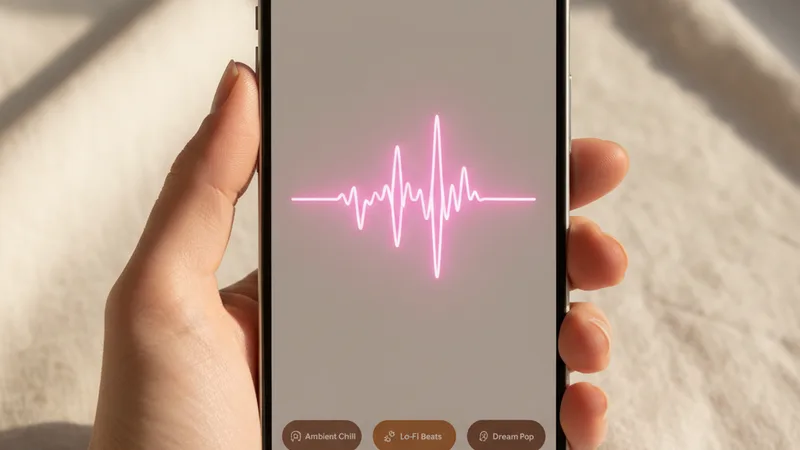
The workflow I have used for three graduation tracks in the last twelve months — one high school, one bachelor's, one PhD. Total time on the most recent run was 4 minutes 18 seconds from opening the app to having the final audio file.
1. Open Muziko and tap Create. Switch to Write Lyrics mode. Graduation songs need the graduate's name, the school name, and at least one specific reference from their years there, so this is the only mode that works.
2. Pick the genre. Confident pop, indie pop, anthemic rock, soulful R&B, and acoustic with a build are the five that consistently land for graduations. Match the genre to the graduate's actual taste — not what you think graduation anthems should sound like.
3. Pick a mood. Confident and euphoric are the two that work for most graduation tracks. Playful works for kindergarten and elementary promotions. Sentimental works for older graduates returning to school after years away.
4. Write six to ten lines of lyrics. Structure that works: two lines about the journey (the specific years, the specific struggle), two lines repeating the graduate's name as a chorus, two lines naming the school or program, and two lines about what comes next. Always specificity over generic praise.
5. Set the tempo and request a key change. "118 bpm with a key change in the final chorus" is the prompt structure that consistently produces graduation-anthem energy. The key change is what makes the cap-toss moment land if the song is timed to it.
6. Generate four to six takes. Each generation runs 8 to 15 seconds in Muziko. Listen on the actual playback system you plan to use — graduation tracks often get played through party speakers or Bluetooth speakers outdoors, and the mix needs to survive that.
7. Save in the highest-quality format. If the graduate is going to share the track on social media, save in the format that preserves the most dynamic range. Compressed audio mastered for streaming sounds thin on cap-toss videos.
For the full mobile workflow walkthrough, the AI song generator for iPhone 2026 guide covers each creation mode in depth.
Writing a graduation prompt that actually sounds like the graduate

A working graduation prompt has six small ingredients. Miss any one and the track lands somewhere between "nice" and "another generic anthem."
The graduate's name, phonetic if unusual. Saoirse becomes Sersha in the lyrics. The AI reads phonetically — it does not need the official spelling.
The school or program, named once. "UCL" is a usable lyric. "The university" is not. Specific institution names give the song an anchor that generic references cannot match. PhD programs work especially well — "the lab in the basement of the chemistry building, six years of midnights" lands harder than any chart pick.
One specific shared memory from the years there. "The dissertation that nearly broke you in March" or "the bus you took at 6 a.m. for the lab job through senior year." The detail is what the graduate feels even if the room does not catch the exact words.
The genre, narrow and matched to them. "Confident indie pop with a build, light synth pad on the verses, drums entering on the second verse, big chorus" is a usable prompt. "Graduation music" produces generic Green-Day-adjacent tracks every time.
The tempo, as a number. 105 bpm for confident mid-tempo. 118 bpm for anthemic. 128 bpm for upbeat dance-pop graduation party energy. Vague directions produce vague results.
A vocal direction and a key change. "Solo female vocal, confident and clear, with backing harmonies in the chorus and a key change in the final chorus." The key change is what gives the song the "we made it" energy that defines a graduation anthem.
A combined working prompt for a PhD graduation:
"Anthemic indie pop graduation song for Maya graduating from UCL, 118 bpm, confident and euphoric, solo female vocal clear and confident with stacked harmonies in the chorus, light synth pad on the verses, full drums entering on the second verse, big chorus with a key change in the final chorus, lyrics about Maya and UCL and the dissertation that nearly broke her in March, two minutes thirty seconds, clean ending."
In testing, that prompt produces a graduation-anthem-quality track in roughly three to four generations about 80% of the time. For more on iterating prompts toward a specific output, the perfect prompts breakdown covers the underlying patterns.
Matching graduation type to genre and tempo: a starter chart
Graduation music is age-sensitive and program-sensitive. A kindergarten promotion needs different energy than a PhD defense after-party. A few patterns that consistently land:
| Graduation type | Genre | Mood | Tempo | Length |
|---|---|---|---|---|
| High school | Confident indie pop or anthemic rock | Confident | 112-122 bpm | 2:30-3:00 |
| Bachelor's degree | Anthemic pop with key change | Euphoric | 110-120 bpm | 2:30-3:00 |
| Master's degree | Confident pop or soul | Confident | 105-115 bpm | 2:30-3:00 |
| PhD or doctoral | Anthemic pop or indie-folk-pop | Confident | 108-118 bpm | 2:45-3:15 |
| Professional school (MD, JD, MBA) | Polished pop with strings | Confident | 105-115 bpm | 2:30-3:00 |
| Returning adult student | Sentimental soul with build | Sentimental | 95-105 bpm | 2:45-3:15 |
| GED or community college | Soulful R&B or country anthem | Confident | 100-110 bpm | 2:30-3:00 |
| Trade school or vocational | Country anthem or hard-working pop | Confident | 105-115 bpm | 2:30-3:00 |
| Kindergarten promotion | Playful children's pop | Playful | 110-125 bpm | 1:30-2:00 |
| Middle school promotion | Upbeat playful pop | Playful | 112-122 bpm | 2:00-2:30 |
Pick the row that matches the graduation. Layer the name, school, and specific reference on top. For the broader genre-by-genre quality breakdown across AI music apps, the best AI music app for iPhone 2026 ranking covers what each handles best.
When AI graduation songs land — and when to skip them
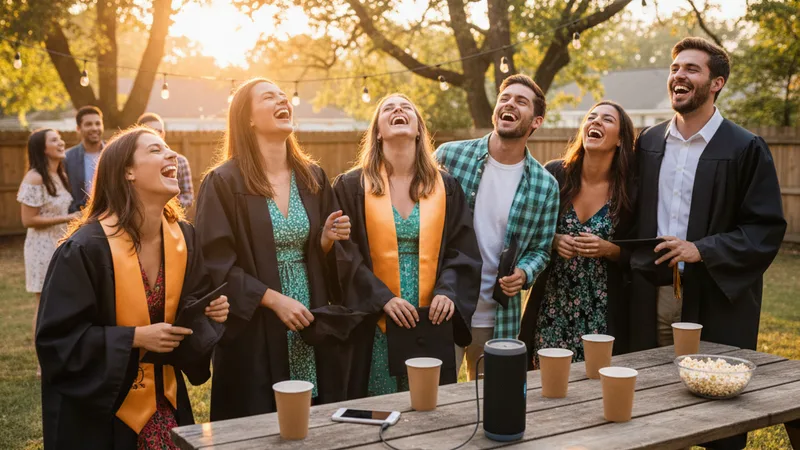
Honest accounting of where AI graduation songs are the right gift and where they are not.
Land brilliantly:
- The graduation party. A custom anthem played at the start of the party — with the graduate's name in the chorus and the school in the lyrics — sets a different tone than the standard playlist. I have watched this work at three different parties; the response is always "wait, who made this?"
- Slideshow soundtracks at the family lunch or dinner. A two-and-a-half-minute custom track scored over a slideshow of the graduate's four years lands harder than any commercial pop song. The specificity of the lyrics does the work.
- Surprise gifts from a parent or sibling. A custom track sent in iMessage the morning of graduation, with one line of context — "I made this last week" — is consistently one of the most-screenshotted graduation gifts in my testing. Costs less than a card.
- Long-distance graduation moments. When a family member cannot attend the ceremony, a custom audio file fills the gap better than any text or phone call. The graduate keeps the file on their phone for years.
- PhD defense after-parties. Doctoral graduations are where a custom song with the actual research topic in the lyrics lands hardest. PhD culture is specific, in-jokey, and references-heavy; AI music handles that texture well.
Skip, or use carefully:
- The actual ceremony itself. Graduation ceremonies almost always have fixed music — Pomp and Circumstance for the procession, the school's alma mater, a planned soloist. Custom AI tracks are for the moments around the ceremony, not the ceremony itself.
- When the graduate is sensitive to AI-generated content. Some graduates, especially in arts or humanities programs, have strong feelings about AI tools. Read the room. If the graduate would be uncomfortable, default to a thoughtful playlist and a long letter instead.
- When the school has a strong song tradition. Some schools have anthems, fight songs, or alma maters that already do the work. Use them. The custom AI track can be reserved for the family party afterward.
- When the AI mispronounces the name and you ship the first take. Always listen to three takes minimum for name pronunciation. Phonetic spellings in the lyrics field fix the remaining cases.
- When the lyrics are too generic. "You did it" produces a generic track every time. "Six years in the chemistry lab basement" produces something specific. The lyric writes the song.
For broader context on AI music for personal events, the can you sell AI-generated music legal guide covers what is and is not allowed across paid and free tiers. For the gentlest introduction to how the tools work, the non-technical guide to AI music generators is the right starting point.
Try this prompt right now
Open Muziko on iPhone, tap Create, switch to Write Lyrics, pick Pop genre and Confident mood, and paste these lyrics (replace Maya with the actual name, UCL with the actual school, and the dissertation line with one specific detail from the graduate's years):
"Maya, four years of buses at six a.m., Maya, the dissertation that nearly broke you in March, Maya, UCL is the road that brought you here, Maya, every long quiet library night, Maya, every yes and every late no, Maya, the cap is in the air now."
Add the prompt note: "Anthemic indie pop graduation song, 118 bpm, confident and euphoric, solo female vocal clear and confident with stacked harmonies in the chorus, light synth pad on the verses, full drums entering on the second verse, big chorus with a key change in the final chorus, two minutes thirty seconds, clean ending."
Generate four to six takes. Listen on the actual speaker you plan to use at the party or family lunch. Pick the take where the name sounds clearest, the key change lands cleanly, and the energy peaks at the chorus rather than the bridge. Save in the highest-quality format your app offers.
In testing, this template produces a usable graduation anthem in roughly four total generations about 85% of the time. For more on long-form personalization patterns, the text to song AI guide walks through turning any description into a track. For a related milestone use case, the AI birthday song guide covers the same workflow with shorter tracks.
Frequently asked questions
How long does it take to make a custom AI graduation song on iPhone?
Realistically, three to seven minutes from opening the app to having a final track exported. The workflow is: pick anthemic pop or indie pop genre, pick a confident or euphoric mood, write six to ten lines of lyrics with the graduate's name, the school name, and at least one specific reference from their years there, set the tempo (105-122 bpm for most graduation tracks) with a key change in the final chorus, generate four to six takes, and save the strongest one. First-time users should budget 10 to 15 minutes for the first track; after one or two songs the workflow consistently runs under five minutes.
Can the AI sing the graduate's name and the school name correctly?
Common English names and well-known schools (Stanford, UCL, Berkeley, MIT, Harvard) are pronounced correctly on the first take about 95 percent of the time. Less common names, less common schools, or acronyms sometimes get mispronounced on early generations. The fix is to spell either phonetically in the lyrics field — Saoirse becomes Sersha, UCL becomes "U-C-L" as three letters, an unusual school name becomes its phonetic spelling. The AI reads the lyrics phonetically and does not need the official spelling, only how to pronounce them. Generating six takes minimum for unusual names or schools produces at least one clean pronunciation almost every time.
What's the best genre for a graduation anthem?
Match the genre to the graduate's actual taste, not to what you think graduation anthems should sound like. Anthemic indie pop with a key change is the safest default for most graduations — it lands across high school, bachelor's, and PhD. Confident soul or R&B works for graduates whose musical taste leans that direction. Country anthems work for graduates from rural backgrounds or country fans. For kindergarten and elementary promotions, switch to playful children's pop at higher tempos. The wrong-genre mismatch is the single most common reason an AI graduation song falls flat.
Should the graduation song have a key change?
Yes, almost always. The key change in the final chorus is what gives graduation anthems their "we made it" energy — it is the moment the cap-toss should land if the song is timed to it, and it is the structural reason songs like Forever Young and We Are Young feel like graduation songs. Prompt the AI specifically: "key change in the final chorus." Most AI music apps in 2026 handle this prompt direction well. If the first generation does not include the key change, prompt again with stronger wording — "modulating up one whole step at the start of the final chorus."
Is it legal to share an AI graduation song on social media or TikTok?
Yes, when generated on the paid tier of a reputable AI music app like Muziko Pro at $34.99 per year, Suno Pro, or Udio Pro. The paid tier grants commercial and personal usage rights including posting the track to TikTok, Instagram, and YouTube. Free-tier generations are usually restricted to personal non-commercial use, which is fine for the family party and the private cap-toss video but can be restricted for the public TikTok post that follows. For graduates who want to share the track publicly, generate on the paid tier to keep all rights clean.
Can I use AI graduation songs for the actual ceremony or only the party?
Generally, the party. Graduation ceremonies almost always have fixed music — Pomp and Circumstance for the procession, the school's alma mater, a planned soloist or band. Custom AI tracks are best for the moments around the ceremony rather than the ceremony itself. Where they shine: the family lunch, the graduation party, slideshow soundtracks, cap-toss videos posted to social media, and surprise gift drops to the graduate before or after the ceremony. Some smaller or more informal ceremonies (homeschool, online programs, GED celebrations) may have flexibility to use custom music during the ceremony itself — check with the program organizer.
Try everything you just read about. Muziko is free to download.