Story to Song AI: Turn Any Story into a Music Track
How story-to-song AI turns a paragraph of narrative into a finished track, what makes a story work as a song input, and example stories with the songs they produce.
There is a specific category of song that does not exist on any streaming service: a song about your grandmother's garden, about the night your dog ran away, about the year you spent learning Portuguese before a trip you never took. These are not commercial subjects — but they are the ones that tend to matter most to the people who lived them. Story-to-song AI is the feature that finally makes these songs reachable.
The mechanic is unusual. You write a short story — a paragraph, a memory, a scene — and the model generates a full song around it. Not your story read aloud over music, but a real song with lyrics, melody, vocals, and instrumentation that captures what the story was about. When it works, it can feel almost spooky — like the song was always there, waiting for someone to ask for it.
This guide is about how story-to-song actually works, what kind of stories produce great songs, the structure I use to write them, and the exact workflow to go from a remembered moment to a finished track.
What story-to-song AI actually does
A story-to-song model is doing two things at once. First, it reads your story and extracts the things that matter to a song — the emotional core, the central characters, the setting, the time of day, the season, any sensory details, and the arc (does the story end where it began, or does something change?). Then it generates lyrics that tell that story in a singable form, and arranges those lyrics into a full song.
The difference between story-to-song and lyrics-to-song is who writes the lyrics. In lyrics-to-song mode, you supply the words and the model arranges them. In story mode, the model writes the words from your story.
This gives you a different kind of creative control. You do not have to write lyrics — you write narrative. The model handles the translation to verse, chorus, and bridge. For people who can describe a memory in plain prose but freeze when asked to write a "song," story mode is the route through.
What counts as a story for story mode
Most things people call stories work. A few specific kinds work especially well:
- A short memory. "The summer my grandmother taught me to make peach cobbler and we ate the first one straight from the pan."
- A scene. "It is 11pm on a Tuesday, the kitchen is empty, and the dishwasher just finished a cycle. I am drinking tea that I did not remember pouring."
- A relationship moment. "We met at a bus stop in the rain. She had a yellow umbrella. I did not ask her name for three weeks."
- An event. "My brother's wedding, the part right before the ceremony when nobody knew where the rings were."
- A long road trip. "Driving across Texas in July with the air conditioning broken and no podcast queued up."
A few categories that work less well:
- Abstract concepts. "What it feels like to be uncertain about your career." The model can write something, but without a concrete scene it tends to land on cliche.
- Multiple characters with named relationships. Songs handle two named people well. Four named people with specific relationships to each other becomes hard to track in 90 seconds of audio.
- Stories with no emotional arc. "I went to the store and bought milk." Fine as a starting point, but the model has to invent the emotional dimension itself.
The simplest test: can you describe the story in three sentences with one specific concrete image? If yes, story mode will probably produce a coherent song.
How to structure a story for the best song output
The shape of your story matters. After hundreds of generations, the stories that produce the strongest songs have three things in common:
A specific image as the anchor
A "specific image" is one sensory detail the model can build the song around. "The smell of cut grass," "the kitchen light at 6am," "the sound of a screen door closing," "a yellow umbrella in the rain." This becomes the recurring motif in the song — it shows up in the chorus, the bridge, the final line.
Stories without a specific anchor tend to produce songs that feel generic. Stories with one usually produce songs that feel like they are about something.
A two-act arc
The strongest story-mode generations have a turn. Something is one way at the start and a different way at the end. The "turn" does not have to be dramatic — it can be as small as a moment of noticing, a realization, or just the passing of time. But there needs to be a before and an after.
A story that is all one moment ("It was nice in the kitchen") produces a song that is all chorus. A story with a turn ("It was nice in the kitchen, until I realized the chair across from me had been empty for a year") produces a song with verses, a chorus, and an emotional pivot in the bridge.
Concrete over abstract, every time
"I felt sad" is abstract. "I put the cup back in the cupboard with the handle facing the wrong way and did not bother to fix it" is concrete. The model can do something with concrete. With abstract, it has to invent the concrete on its own, and the result feels less personal.
This is the same rule that applies to writing prose. The detail is the song.
A worked example
Here is a story I wrote in about 90 seconds:
"The summer my grandmother taught me to make peach cobbler. We were in her kitchen in Georgia, and the screen door slammed every time my cousins ran in and out. She let me cut the butter into the flour with my hands. The first cobbler was burned on the edges and we ate it anyway, straight from the pan, with vanilla ice cream melting too fast in the heat."
That story has all three ingredients: a specific anchor (the smell of peach cobbler, the screen door), a small two-act arc (the burned cobbler we ate anyway), and concrete sensory detail throughout (cutting butter into flour, ice cream melting too fast).
When I put this into Muziko's Story Mode with a "country folk" genre tile and "warm storyteller delivery" vocal cue, the model returned a song with lines like "the screen door slammed, the summer hummed," and "we ate the burned edges anyway." The chorus was about her hands. The bridge was about the heat. The song was about my grandmother in a way I would have struggled to write directly.
The story-mode workflow on iPhone
End-to-end on Muziko, this takes about 5 minutes:
1. Write the story in your notes app
Three to six sentences. Use the structure above: anchor, two-act arc, concrete detail. Do not worry about songwriting craft — write it as a memory, not as lyrics.
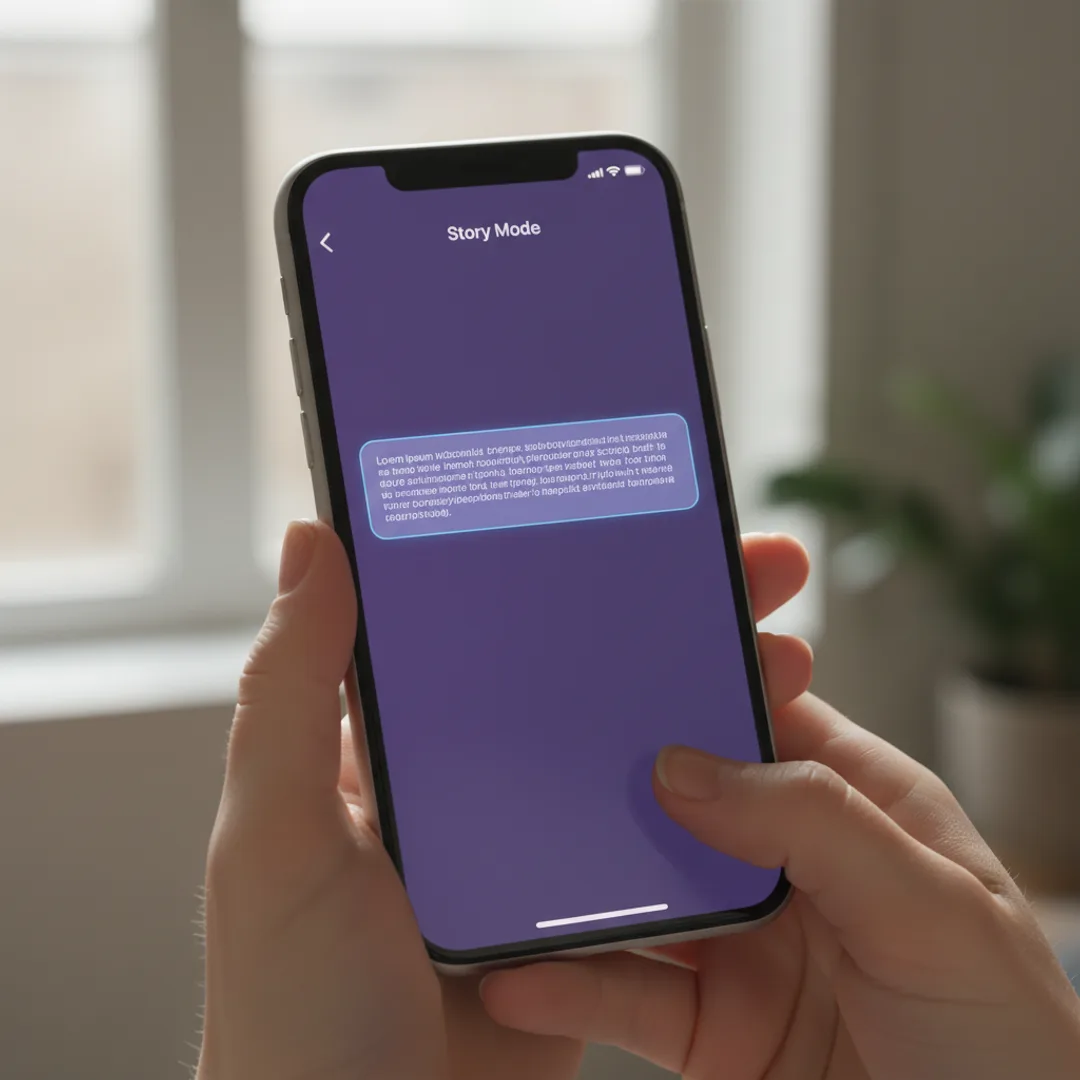
2. Open Muziko and switch to Story Mode
Open Muziko, tap Create, and switch to Story Mode. Paste your story.
3. Pick a genre and add a style cue
The story decides what the song is about. The genre tile and style cue decide what the song sounds like.
For memories and intimate scenes, Folk or Acoustic work best. For energetic events (weddings, parties), Pop or Indie. For melancholic stories, Lo-fi or Ambient. For ones with a sense of motion (road trips, transit), Country or Soft Rock.
The vocal cue matters as much as the genre. Try "warm storyteller delivery" for memories, "vulnerable cracking delivery" for sadness, "wistful airy delivery" for nostalgia.
4. Generate two takes
Two takes lets the model interpret your story two different ways. Sometimes the first take picks the surface meaning and the second take picks something deeper.
5. Listen, pick the take, save
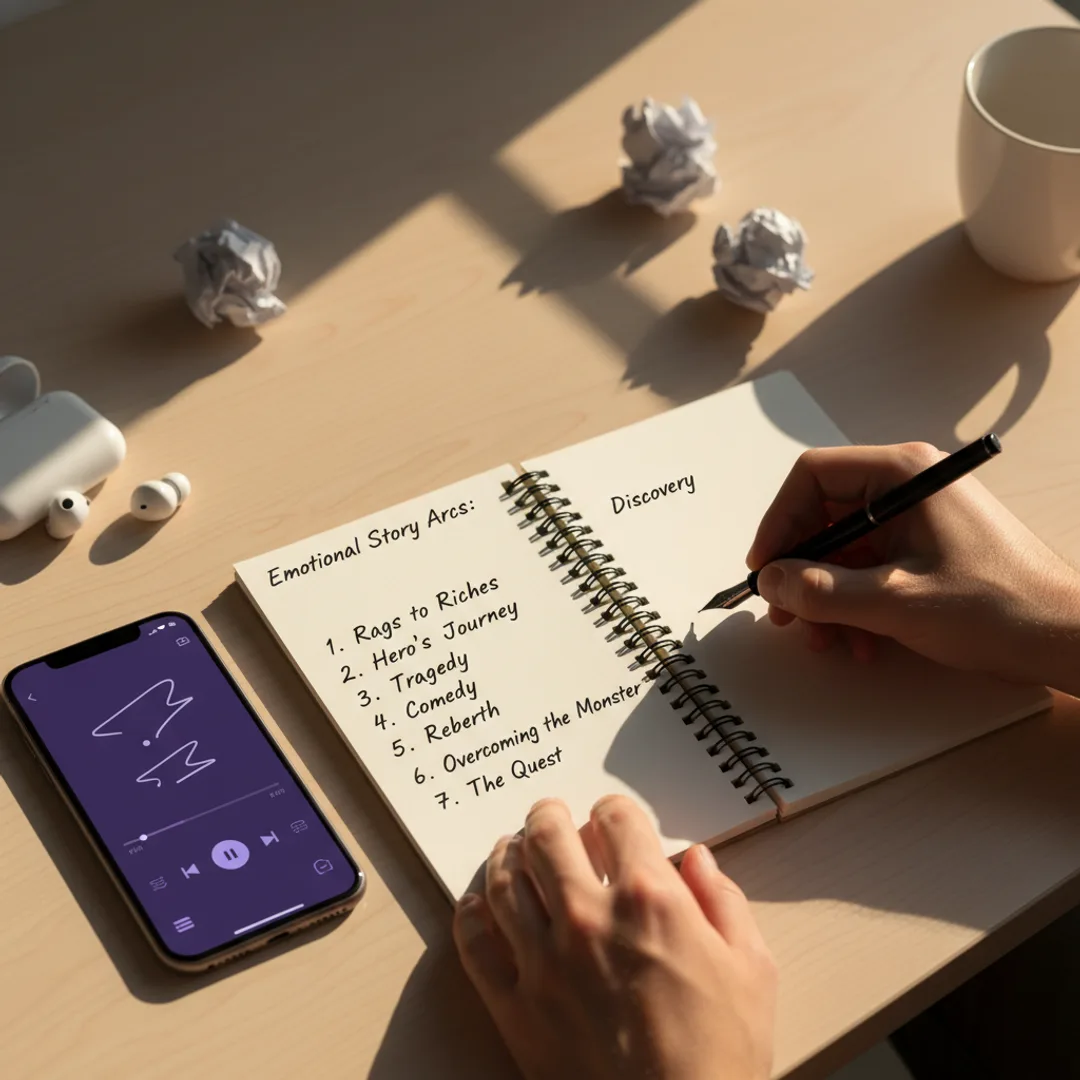
Use headphones. Pick the take that feels truer to your story. If neither feels right, the issue is usually the genre or vocal cue, not the story — adjust one and regenerate.
For more on the broader iPhone workflow, the 3-minute walkthrough covers Muziko's full Create flow.
Use cases where story mode is the right tool
Some specific things story mode is unusually good at:
- Birthday and anniversary songs. Write the story of how you met them, or a favorite memory together. Story mode turns it into a song you can send.
- Memorial songs. A song about someone who has died, built from a specific memory of them. This is one of the most emotionally meaningful uses of AI music I have seen, and people tend to use it once and treasure the result.
- Wedding songs. Walk-down-the-aisle music written from the story of the proposal, or the first date.
- Travel journal songs. A song per trip, written from the strongest single memory of that trip.
- Children's songs. Write the story of a child's stuffed animal or a made-up adventure. The model handles whimsy well.
- Eulogies for things that are gone. A song about a place that no longer exists, a friendship that ended, an apartment you used to live in.
Story mode is much less good at writing club songs, party anthems, or pop hits — songs that are about energy rather than narrative. For those, text-to-song and lyrics-to-song are the better fits.
Commercial use of story-mode output
Songs generated from your own original story are owned by you under most current AI music app terms — including Muziko Pro at $34.99/year — and can be released, monetized, or licensed.
The caveat is the story itself. If you wrote it, you own it. If you took it from a book, a memoir, or someone else's published work, the underlying narrative copyright still applies.
For more on the broader legal landscape, the Wikipedia entry on AI music copyright is a useful primer.

Try this exact story right now
Open Muziko, switch to Story Mode, pick Folk as the genre and Calm as the mood. Paste this story:
"The summer I learned to drive, my dad used to take me to the empty parking lot behind the grocery store after it closed at 9. He sat in the passenger seat with his hands folded in his lap, and he never once raised his voice. The first night I drove home on a real road, he turned the radio up so we did not have to talk, and I think we were both proud and a little sad."
Add this style cue:
"Country folk, male vocals with a warm storyteller delivery, fingerpicked guitar with light strings, around 88 bpm, intimate close-mic'd mix."
In testing, this combination produces a release-quality folk song about a father-and-child memory on the first generation about 70% of the time. The second generation usually catches more of the bittersweet undertone.
Frequently asked questions
Try everything you just read about. Muziko is free to download.