
![AI Blues Generator: Delta, Chicago & Soul Blues [Tested]](/_next/image?url=%2Fimages%2Fblog%2Fai-blues-generator-delta-chicago-soul-blues%2Fhero.webp&w=3840&q=75)
AI Blues Generator: Delta, Chicago & Soul Blues [Tested]
AI blues generator tested across delta, Chicago, and soul blues on iPhone. Authentic 12-bar feel, real guitar tone, and genuine grit — Muziko in 5 minutes.
Blues is the genre most likely to expose an AI as a fraud.
I've heard people say this for two years, and I half-believed it. Jazz fans said the same thing about jazz — that you can't fake the conversation between musicians, the micro-timing, the decision to hold a note one beat longer than the chord strictly allows. And yet when I started actually testing AI on jazz, the results were more convincing than the skeptics predicted.
Blues is harder. Blues has even less harmonic complexity to hide behind — it's twelve bars, three chords, and a feeling. If the feeling isn't there, you have nothing. The genre lives or dies on the space between notes, on the bend of a guitar string, on a vocal that sounds like it costs something to sing.
So I ran two months of blues tests. Delta, Chicago, Texas, soul blues, blues-rock, slow blues, shuffle blues. Here's what I found — and where I think the skeptics are still partially right.
Why generic blues tracks fall short
The blues library problem isn't about quantity. There are thousands of royalty-free blues tracks available. The problem is that almost all of them are missing the one thing blues requires.
Generic blues sounds competent, not felt. Every stock blues library has tracks that check the boxes: 12-bar structure, shuffle rhythm, guitar bends, harmonica somewhere in the mix. What they don't have is the sense that someone meant it. Blues communicates specificity — a specific kind of hurt, a specific time of night, a specific weight. Stock tracks produce blues-shaped music without the weight.
The guitar tone is always safe. Delta blues guitar should sound like it was recorded in a room with bad acoustics in 1935. Chicago blues should sound like a small club in 1955, electric and buzzing with crowd noise. Stock blues guitar is always recorded clean, properly EQ'd, ready for a bourbon commercial. It's blues without the dirt.
Subgenre differences are significant. Delta blues, Chicago blues, Texas blues, Piedmont blues, soul blues, blues-rock, jump blues — these are not the same music. Delta is sparse and raw, often just voice and slide guitar. Chicago is electric and full-band. Texas has a loose swinging feel distinct from both. Piedmont uses fingerpicking patterns that come from ragtime. Stock libraries collapse all of it into "blues guitar backing track."
The vocal style matters enormously. A Chicago blues vocal sounds different from a Delta field holler sounds different from a soul blues singer sounds different from a contemporary Americana voice. Generic libraries avoid the rawer vocal styles entirely because they're harder to license for corporate clients.
What custom AI blues adds
When you generate blues with specific prompts on Muziko, you get access to things stock libraries can't provide:
- Subgenre specificity that holds up. "1930s Delta blues" produces a noticeably different result than "1955 Chicago electric blues" or "Texas shuffle blues." The model has learned the sonic signatures of each tradition.
- Controlled guitar texture. Slide guitar vs. fingerpicking vs. electric rhythm — specify it and the model adjusts. "Bottleneck slide guitar with open G tuning" produces a different texture than "single-coil electric guitar with slight overdrive."
- Harmonica placement. Specify "diatonic harmonica call-and-response between vocal lines" and the model typically includes harmonica fills in the expected structural positions.
- Vintage production textures. "Mono room recording with tape saturation" or "lo-fi 1940s field recording quality" pushes the model toward period-appropriate production — less polished, more character.
- Vocal styles across the spectrum. Raw Delta moan, Chicago electric shout, soulful mid-century gospel influence, or contemporary Americana clarity. Each is a distinct prompt behavior.
- 12-bar vs. other structures. Blues has structural variants — 8-bar blues, 16-bar blues, slow blues with stretched bars. You can specify which and the model adjusts.
I'll also say: blues lyric writing is one of the strongest use cases for Muziko's Write Lyrics mode. Blues lyrics follow conventions — repetition of the first line, resolution in the third, the call-and-response tradition — that the model has internalized well. For more on that, see the AI lyrics and prompts guide.
Step-by-step in Muziko
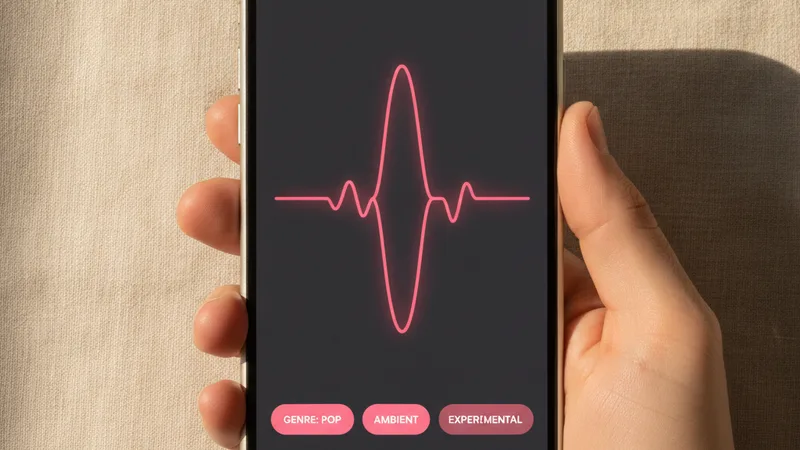
Here's how I generated a Chicago blues track that I actually kept and used as a reference recording:
- Open Muziko, choose between Describe and Write Lyrics. For blues with your own words — classic AAB verse structure or something more personal — Write Lyrics gives you control. For instrumental blues or when you want the model to handle the lyric, Describe works well.
- Select Blues genre tag. Muziko's blues engine is separate from rock and country — don't use the generic "acoustic" tag if you want real blues texture.
- Set mood to Melancholy, Soulful, or Raw. Avoid "Happy" — it pushes the model toward jump blues or boogie-woogie, which is a different tradition. "Raw" produces the most Delta-adjacent results.
- Write a detailed prompt with subgenre, era, guitar style, and vocal character. Specifics matter more in blues than in almost any other genre. Generic "blues song" gets you a safe backing track.
- Generate. 8-15 seconds.
- Listen specifically to the guitar. Blues lives in the guitar tone. Is it dirty enough? Does it bend? Does it sit in the right register for the subgenre? If the guitar is wrong, the prompt needs adjustment before anything else.
- Regenerate two to four times. Blues tone varies significantly run-to-run. Sometimes the model finds a particularly warm vintage guitar texture on the third take that makes the whole thing land.
- Refine with specific prompt edits. "More slide guitar," "add harmonica fills," "rougher vocal," "slower tempo," "more room sound." Small additions shift the texture noticeably.
- For authentic delta feel, ask for less. Paradoxically, less-dense prompts produce more convincing Delta blues. "Sparse voice and slide guitar, nothing else" gives you more space than a fully arranged track.
- Export and use. Blues works beautifully as documentary score, podcast background, video soundtrack, or demo for your own songwriting.
Writing the prompt that has grit
Most people type "blues song" and get polished backing-track blues with no soul. The prompts that produce something worth keeping are built in layers.
Layer 1: Subgenre + era. This is the most important element. "1930s Mississippi Delta blues" gives the model a specific sonic tradition. "1955 Chicago electric blues" gives a different one. "1960s Texas blues shuffle" different again. "Contemporary soul blues" gives a modern reference. The era anchor pulls in the appropriate production texture, guitar style, and vocal tradition.
Layer 2: Guitar specification. Blues is a guitar-forward genre — the guitar tone is the personality. "Bottleneck slide guitar in open D tuning, raw and buzzy" (Delta). "Single-coil electric guitar, slightly overdriven, clean attack" (Chicago). "Semi-hollow electric with warm mid-heavy tone" (soul blues). "Stratocaster tone with crisp picking" (Texas). Pick one and describe it.
Layer 3: Supporting instruments. Delta blues: often just guitar and vocal, maybe harmonica. Chicago blues: electric guitar, bass, drums, harmonica, sometimes piano. Texas blues: guitar, bass, drums. Soul blues: full band with organ and horn section. Piedmont: fingerpicked acoustic guitar only. More instruments is not more authentic — match the tradition.
Layer 4: Vocal character. "Raw field holler, unpolished" (Delta). "Powerful Chicago electric shout" (Chicago). "Soulful mid-range with gospel overtones" (soul blues). "Smooth contemporary voice with blues phrasing" (modern). "No vocals, instrumental" (for background use). The vocal is where most generic blues fails — specify yours.
Layer 5: Production texture. "Lo-fi mono recording, tape hiss, room sound" (period-accurate). "Clean vintage production, warmth without distortion" (1960s studio blues). "Modern production with vintage instruments" (contemporary blues). "Live-room feel, slight reverb, no polish" (club recording aesthetic).
Here's a Delta blues prompt I keep returning to:
"1930s Mississippi Delta blues, slow 70 BPM, bottleneck slide guitar in open G tuning with buzzy lo-fi tone, raw unpolished male vocal with field holler influence, harmonica answer phrases between vocal lines, no other instruments, mono tape recording quality, sparse and sparse and heavy"
And a Chicago electric blues prompt:
"1955 Chicago electric blues, medium shuffle at 120 BPM, single-coil electric guitar with slight overdrive, powerful shouted male vocal, upright bass, brushed snare and kick drum, diatonic harmonica fills, small club atmosphere, warm but electric"
Both produce consistently convincing results across multiple runs.
Blues subgenre chart
Two months of testing across the blues tradition. Here's what produces the most convincing results:
| Subgenre | BPM | Guitar Style | Instruments | Vocal | Era Anchor |
|---|---|---|---|---|---|
| Delta blues | 60-90 | Bottleneck slide, open tuning | Guitar + vocal, harmonica optional | Raw, field holler | "1920s-1940s Mississippi Delta" |
| Chicago blues | 110-130 | Single-coil electric, slight OD | Full electric band + harmonica | Powerful shout | "1950s Chicago electric" |
| Texas blues | 110-130 | Stratocaster, clean to dirty | Guitar, bass, drums | Smooth, expressive | "1960s Texas, SRV country" |
| Piedmont blues | 90-110 | Fingerpicked acoustic | Guitar only | Warm, conversational | "1930s Piedmont ragtime-blues" |
| Soul blues | 70-100 | Semi-hollow electric | Full band + horns + organ | Soulful, gospel-tinged | "1960s-70s soul blues" |
| Jump blues | 150-180 | Clean electric | Full swing band + horns | Shouted, upbeat | "1940s jump blues, Louis Jordan" |
| Blues-rock | 100-140 | Heavy electric, Marshall tone | Loud trio: guitar, bass, drums | Powerful, rock-influenced | "1960s-70s blues-rock, Clapton/Hendrix" |
| Slow blues | 50-75 | Electric, heavy bends | Guitar-forward, small band | Deeply expressive | "12/8 slow blues, emotional weight" |
| Boogie-woogie | 140-180 | Piano-led | Piano, bass, drums | Upbeat, fun | "1930s-40s boogie, barrelhouse piano" |
| Contemporary blues | 90-120 | Modern electric | Modern production | Clean, Americana | "2020s Americana blues, Joe Bonamassa" |
The clearest demo of how much the era anchor matters: try "delta blues" and "Chicago blues" with the same emotional prompt. The model produces completely different arrangements — sparse and raw for Delta, full electric band for Chicago. One prompt change, two different genres.
When AI blues works, when it doesn't
It works when:
- You're writing a blues song and need a demo track to test how your lyrics feel against the melody
- You're making content — documentary scores, podcast intros, video backgrounds — where original blues music is perfect but stock blues is too polished
- You're a songwriter learning the blues tradition and want to hear what different subgenres sound like with your specific prompt
- You want background music for a bar, restaurant, or event with a specific blues atmosphere
- You're creating a playlist of original music for personal listening
It falls short when:
- You need a single guitar bend that sounds exactly like B.B. King's vibrato or Stevie Ray Vaughan's attack. The model gets the style; it doesn't replicate the individual. Real guitar players are irreplaceable at that level.
- The Delta blues track isn't sparse enough. The model sometimes adds too many layers. Explicitly prompt "no drums, no bass, just guitar and voice" to strip it back.
- You need it to feel improvised. Blues improvisation — the spontaneous conversation of a live performance — is something AI approximates but doesn't replicate. The tracks sound composed, not improvised.
- You need stems for a serious production. Muziko outputs stereo masters. For stems, the stem extraction guide covers your options.
Compared to Suno and Udio: both handle blues with varying success. In my testing, Muziko's era-anchoring produces more period-accurate results for historical subgenres (Delta, Chicago). Suno skews more contemporary. For the full comparison, see Muziko vs Suno.
Try this prompt right now
Open Muziko, tap Describe, and paste this in:
"1955 Chicago electric blues, slow shuffle at 110 BPM, single-coil electric guitar with slight overdrive and string bends, powerful male vocal, harmonica fills between vocal lines, upright bass, brushed snare, small club warmth, genuine grit"
Generate four takes. Listen specifically to the guitar on each — find the take where the bends feel heaviest. That's your reference point.
Open Muziko in the App Store →
Frequently asked questions
Can AI generate authentic-sounding blues music?
Yes, with specific era and subgenre prompts. Delta, Chicago, Texas, and soul blues all produce convincing results when you anchor the prompt to a specific tradition — guitar style, era, vocal character. Generic "blues" prompts produce generic results. Specific prompts produce specific blues.
What is the 12-bar blues structure and can AI follow it?
The 12-bar blues is the most common blues structure: four bars of tonic, two of subdominant, two of tonic, one each of dominant and subdominant, two of tonic. Muziko's blues engine follows this structure by default when you specify blues as the genre. You can also specify 8-bar or 16-bar variants in the prompt.
Can AI generate Delta blues specifically?
Yes. Specify "1930s Mississippi Delta blues, bottleneck slide guitar in open G, sparse, just voice and guitar" and the model produces a noticeably rawer, sparser result than generic blues. The key is telling it to strip back the arrangement — the model tends to add instruments by default.
Is AI blues music good for documentary scores?
It's one of the best use cases. Documentaries about American history, the South, music history, or social justice frequently need blues-adjacent background music. Original AI-generated blues sidesteps the sample clearance issues that come with using historical recordings. See the AI music licensing guide for details.
Can I write my own blues lyrics and have AI set them to music?
Yes, and blues is particularly well-suited to Write Lyrics mode. The classic AAB blues verse — repeat the first line, resolve in the third — is a structure the model handles naturally. Write your words, describe the subgenre and tempo, and the model fits a melody to your syllables.
How does AI blues compare to hiring a blues guitarist?
A real blues guitarist brings improvisation, authentic string bend weight, and the ineffable sense of someone who's earned the style. For final recordings and live performance, hire the guitarist. For demos, content scores, and prototyping, AI blues is faster and surprisingly credible at the genre level.
Try everything you just read about. Muziko is free to download.
![AI Soul Music Generator: Motown Warmth [Tested 2026]](/_next/image?url=%2Fimages%2Fblog%2Fai-soul-music-generator-motown-warmth%2Fhero.webp&w=3840&q=75)
![AI Funk Generator: Heavy Grooves That Hit [Tested]](/_next/image?url=%2Fimages%2Fblog%2Fai-funk-generator-heavy-grooves-that-hit%2Fhero.webp&w=3840&q=75)
![AI Amapiano Generator: Log Drum Tracks [Tested 2026]](/_next/image?url=%2Fimages%2Fblog%2Fai-amapiano-generator-log-drum-tracks%2Fhero.webp&w=3840&q=75)